AI optimization software for visibility improvement tracks how often ChatGPT, Claude, Perplexity and Gemini mention your brand, shows which competitors appear in your place, and tells you what to change to earn more mentions. In 2025 the category splits into monitoring-only tools ($149–$799/month) and integrated platforms that also generate and publish optimized content. The best choice depends on which AI assistants your buyers use and whether your team can act on the data.
The rules of SEO are being rewritten in 2025. While you've spent years optimizing for Google's algorithms, a new generation of AI systems (ChatGPT, Claude, Perplexity, and Gemini) now answers millions of queries that would have traditionally gone to search engines. These AI models don't rank websites. They synthesize information and recommend solutions directly in their responses, often without showing users a single search result.
If your brand isn't appearing in AI-generated answers, you're invisible to a rapidly growing segment of your target audience. A prospect asks ChatGPT for marketing automation recommendations, and your competitor gets mentioned while you don't. Traditional analytics tools weren't built for this reality: Google Analytics can't tell you if ChatGPT mentioned your brand yesterday, and SEMrush can't track your visibility in Perplexity's responses.
That is the gap AI optimization software for visibility improvement fills: platforms that monitor how often your brand appears in AI-generated content, analyze the context of those mentions, and help you optimize your digital presence for AI recommendation algorithms. Here are the leading platforms that help you track, analyze, and improve how AI systems perceive and recommend your brand.
1. IndexPilot
Best for: Comprehensive AI visibility tracking across multiple LLM platforms with automated monitoring and competitive analysis
IndexPilot is a specialized AI visibility optimization platform designed specifically to track how your brand appears in responses from ChatGPT, Claude, Perplexity, and other large language models.
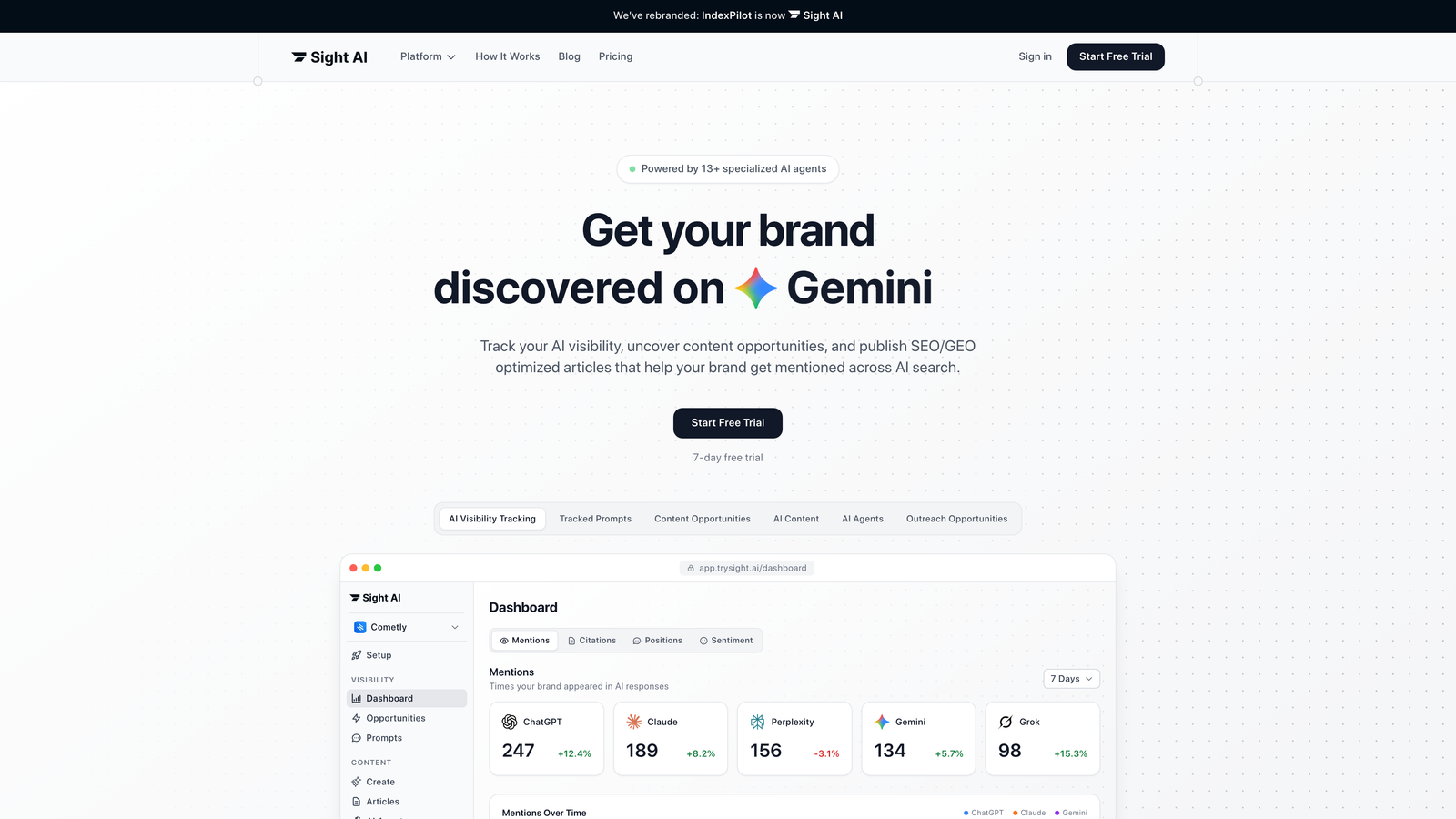
The platform monitors thousands of relevant queries daily and provides detailed analytics on when, where, and how your brand gets mentioned in AI-generated content.
Where This Tool Shines
IndexPilot excels at providing real-time visibility into your brand's presence across multiple AI platforms simultaneously. Unlike manual checking or generic monitoring tools, it automates the process of querying various LLMs with relevant prompts and tracking whether your brand appears in the responses.
The platform's strength lies in its ability to identify patterns in AI recommendations—showing you which types of queries consistently include your brand, which competitors appear alongside you, and which queries you're missing entirely. The competitive intelligence features are particularly valuable, allowing you to benchmark your AI visibility against competitors and identify gaps in your positioning.
Key Features & Capabilities
Multi-platform AI monitoring: Tracks your brand across ChatGPT, Claude, Perplexity, Gemini, and other LLMs simultaneously.
Automated daily query testing: Runs customizable prompt libraries relevant to your industry without manual intervention.
Competitive visibility tracking: Shows how often competitors appear in similar queries compared to your brand.
Sentiment analysis: Analyzes brand mentions to understand positive, neutral, or negative context in AI responses.
Source attribution: Reveals which content pieces AI models reference when mentioning your brand.
Historical trending data: Tracks visibility improvements over time to measure optimization efforts.
Alert system: Notifies you of sudden changes in mention frequency or sentiment shifts.
Query gap analysis: Identifies high-value prompts where you should appear but currently don't.
Best For / Ideal Users
IndexPilot is ideal for B2B SaaS companies, digital marketing agencies, and brands that rely heavily on organic discovery and recommendations. It's particularly valuable for businesses in competitive categories where AI-generated recommendations could significantly influence purchase decisions.
Marketing teams focused on emerging ai seo strategies will find the platform essential for staying ahead of the AI-driven search curve. The platform's source attribution features reveal which content pieces AI models reference, enabling teams to apply targeted ai content optimization techniques.
2. BrandGPT
Best for: Tracking brand visibility specifically in Perplexity AI's search results and citation patterns
BrandGPT is a monitoring platform designed for the unique architecture of Perplexity AI, which combines LLM responses with real-time web search and explicit source citations.
This tool tracks not only brand mentions but also which of your content pieces get cited as sources.
Where This Tool Shines
Because Perplexity AI shows source citations for its responses, BrandGPT can track the specific content pieces that drive your brand mentions. This creates a direct connection between your content strategy and AI visibility—you can see exactly which blog posts, case studies, or landing pages are being referenced by Perplexity's models.
The platform helps you optimize content specifically for citation by Perplexity, which differs from traditional SEO optimization. You can identify content gaps where competitors are getting cited instead of you and adjust your content strategy accordingly. The citation intelligence reveals patterns in what types of content Perplexity's algorithms favor, from comprehensive guides to data-driven research pieces.
Key Features & Capabilities
Brand Mention Tracking: Monitors when and how your brand appears in Perplexity AI responses across thousands of relevant queries.
Citation Analysis: Shows which specific URLs from your domain get referenced as sources in AI-generated answers.
Query Performance Data: Reveals which searches trigger your brand mentions and which content pieces drive those citations.
Competitor Citation Tracking: Identifies content gaps by showing when competitors get cited instead of your brand.
Topic Clustering: Groups queries by subject area to show which topics drive the most visibility for your brand.
Content Optimization Recommendations: Provides actionable suggestions based on citation patterns to improve content performance.
Best For / Ideal Users
BrandGPT is perfect for content-driven businesses, publishers, and companies with substantial blog or resource libraries. It's particularly valuable for B2B companies that invest heavily in thought leadership content and want to ensure that investment translates into AI visibility.
SEO teams looking to optimize for the next generation of search will find the citation intelligence especially actionable. Content strategists can use the platform to identify which content formats and topics generate the most AI citations, then replicate those patterns across their content library.
Pricing
Pricing starts at $149/month for basic tracking, with professional plans at $399/month including competitive analysis and content optimization features.
3. Perplexity Insights
Best for: Content publishers and B2B companies tracking which specific articles and resources get cited by Perplexity AI's hybrid search-and-synthesis system
Perplexity Insights is a specialized monitoring platform built specifically for Perplexity AI's unique architecture, which combines large language model responses with real-time web search and explicit source citations.
Where This Tool Shines
Perplexity Insights creates a direct line of sight between your content strategy and AI visibility that other monitoring tools can't match. Because Perplexity AI shows clickable source citations for its responses, this platform tracks not just brand mentions but the exact URLs being referenced—your blog posts, case studies, product pages, or resource guides.
This citation intelligence transforms AI visibility from abstract monitoring into actionable content optimization. You can see that your "Complete Guide to Marketing Automation" gets cited frequently while your product comparison pages don't, revealing exactly where to focus optimization efforts. The platform identifies content gaps by showing you which topics trigger competitor citations instead of yours, enabling strategic content development that directly improves AI visibility.
Key Features & Capabilities
Citation Source Tracking: Identifies which specific URLs from your domain get referenced in Perplexity responses, creating direct feedback on content performance.
Query Performance Analysis: Shows which search queries trigger your brand mentions and citations, revealing high-value topics for content expansion.
Competitor Citation Intelligence: Tracks which competitor content pieces get cited for queries where you're absent, identifying content gaps to fill.
Topic Clustering: Groups related queries to show which subject areas drive the most visibility, guiding content strategy prioritization.
Content Optimization Recommendations: Provides specific suggestions for improving citation probability based on successful content patterns.
Best For / Ideal Users
Perplexity Insights is perfect for content-driven businesses with substantial blog libraries, resource centers, or knowledge bases. B2B companies investing heavily in thought leadership content will find the citation intelligence particularly valuable—you can finally measure whether that content investment translates into AI visibility.
SEO teams transitioning from traditional search optimization to AI-era strategies benefit from the clear connection between content quality and AI citations. Publishers and media companies can track which articles get referenced by AI systems, informing editorial strategy.
Pricing
Pricing starts at $149/month for basic citation tracking and query monitoring, with professional plans at $399/month including competitive analysis and content optimization features. Enterprise solutions available for organizations with large content libraries requiring comprehensive tracking.
4. Claude Tracker
Best for: Monitoring brand visibility in Anthropic's Claude AI with focus on conversational context and recommendation quality
Claude Tracker specializes in monitoring how your brand appears in responses from Anthropic's Claude models, with particular attention to the conversational context and quality of recommendations.
Where This Tool Shines
Claude Tracker excels at analyzing the qualitative aspects of brand mentions in Claude's responses. Rather than just counting mentions, it evaluates how your brand is positioned within longer, more detailed responses that Claude is known for.
The platform tracks whether your brand is recommended with caveats, positioned as a premium option, or suggested for specific use cases. This contextual intelligence is particularly valuable because Claude users often engage in more detailed, consultative conversations where the quality of recommendation matters more than simple visibility. The tool captures full dialogue threads, showing how your brand enters conversations naturally rather than just appearing in list-format responses.
Key Features & Capabilities
Mention tracking across all Claude model versions: Monitors current and newly released Claude models to track visibility changes across updates.
Conversational context analysis: Shows full dialogue threads revealing how your brand is introduced and discussed in multi-turn conversations.
Recommendation quality scoring: Evaluates positioning and description quality based on how favorably your brand is presented.
Use case mapping: Reveals which specific scenarios and customer situations trigger brand mentions.
Competitor positioning analysis: Tracks how competitors are positioned relative to your brand within Claude's responses.
Sentiment and tone analysis: Evaluates the descriptive language Claude uses when discussing your brand.
Custom conversation testing: Simulates specific customer scenarios to predict how Claude would recommend your brand in real situations.
Best For / Ideal Users
Claude Tracker is ideal for premium brands and enterprise software companies where purchase decisions involve detailed evaluation and comparison. It's particularly valuable for companies targeting sophisticated buyers who use AI assistants for in-depth research rather than quick recommendations.
Professional services firms and high-consideration B2B products benefit most from the detailed contextual analysis. If your sales cycle involves consultative conversations and your prospects value nuanced recommendations, Claude Tracker provides the intelligence you need to optimize for this audience.
Pricing
Plans begin at $179/month for core monitoring features, with advanced plans at $449/month including competitive intelligence and custom conversation testing. Enterprise packages available for comprehensive tracking programs.
5. AI Mention Monitor
Best for: Content publishers and brands tracking which specific articles and pages get cited as sources in Perplexity AI's responses
AI Mention Monitor is a specialized monitoring platform built specifically for Perplexity AI's unique architecture, which combines language model responses with real-time web search and explicit source citations.
Where This Tool Shines
The platform's greatest strength lies in its ability to track the specific content pieces that drive your brand mentions in Perplexity. Unlike other AI systems that synthesize information without showing sources, Perplexity displays citations for its responses. This creates a direct, measurable connection between your content strategy and AI visibility.
You can see exactly which blog posts, case studies, or landing pages Perplexity references when recommending your brand. This intelligence transforms AI visibility from abstract monitoring into actionable content optimization. When a competitor gets cited instead of you for a particular query, you can analyze their content structure, depth, and approach to identify specific improvements for your own content.
Key Features & Capabilities
Brand Mention Tracking: Monitors how frequently your brand appears in Perplexity responses across relevant queries.
Citation Analysis: Identifies which specific URLs from your domain get referenced as sources in AI-generated answers.
Query Performance Data: Shows which search queries trigger citations of your content and brand mentions.
Competitor Citation Tracking: Reveals which competitor content pieces get cited for queries where you should appear.
Topic Clustering: Groups queries by subject area to show which content categories drive the most AI visibility.
Content Gap Identification: Highlights topics where competitors consistently get cited while your content is absent.
Search Console Integration: Correlates traditional Google Search performance with Perplexity citation patterns to identify optimization opportunities.
Best For / Ideal Users
AI Mention Monitor works exceptionally well for content-driven businesses with substantial blog libraries, resource centers, or knowledge bases. Publishers, B2B companies investing in thought leadership, and brands with comprehensive educational content will find the citation intelligence particularly valuable.
SEO teams looking to optimize for next-generation search behavior benefit from understanding exactly which content attributes drive citations. Content strategists can use the platform to identify high-value topics and content formats that consistently earn Perplexity references.
The tool is especially useful for companies in competitive categories where multiple brands publish similar content. The citation analysis reveals what differentiates content that gets referenced from content that gets ignored.
Pricing
Pricing starts at $199/month for basic citation tracking and brand monitoring, with professional plans at $499/month including competitive analysis and content gap identification. Enterprise solutions available for large-scale content optimization programs.
6. LLM Visibility Pro
Best for: Technical SEO teams focused on optimizing content specifically for AI model training and retrieval
LLM Visibility Pro takes a technical approach to AI visibility, focusing on the underlying factors that influence whether AI models reference your content.
Where This Tool Shines
Unlike tools that simply monitor mentions, LLM Visibility Pro helps you understand and optimize the technical factors that make your content more likely to be referenced by AI models. The platform analyzes content structure, schema markup, entity relationships, and other technical elements that influence how AI systems understand and retrieve your information.
It provides specific recommendations for improving content in ways that increase AI visibility, such as optimizing for entity recognition, improving content clarity for model comprehension, and structuring information for easier extraction. The technical depth makes it particularly valuable for teams that want to systematically improve visibility through optimization rather than just tracking performance.
Key Features & Capabilities
Technical Content Analysis: Evaluates your content structure and identifies elements that improve or hinder AI comprehension.
Schema Markup Recommendations: Provides specific structured data suggestions that help AI models better understand your content context.
Entity Relationship Mapping: Shows how your brand connects to relevant topics and concepts in ways AI systems recognize.
Content Structure Optimization: Identifies formatting and organizational improvements that increase citation probability.
Competitive Technical Analysis: Reveals why competitors get mentioned more frequently from a technical perspective.
Training Data Likelihood Scoring: Estimates whether your content appears in model training datasets based on technical signals.
Retrieval Optimization Recommendations: Suggests specific changes to improve how easily AI models can extract and reference your information.
Technical SEO Tool Integration: Connects with platforms like Screaming Frog and Sitebulb for comprehensive technical analysis.
Best For / Ideal Users
LLM Visibility Pro is perfect for technical SEO specialists, content strategists with technical expertise, and development teams working on content optimization. It's particularly valuable for companies with large content libraries that want to systematically improve AI visibility through technical optimization rather than just monitoring.
Publishers and content platforms benefit from the detailed technical recommendations that can be applied across hundreds or thousands of pages. Organizations with dedicated technical SEO resources will appreciate the depth and actionability of the platform's insights.
Pricing
Plans start at $299/month for technical analysis and recommendations, with professional plans at $699/month including competitive analysis and integration features. Enterprise solutions available for large-scale content optimization programs.
7. Gemini Brand Tracker
Best for: Tracking brand visibility specifically in Google's Gemini AI with integration into broader Google ecosystem analytics
Gemini Brand Tracker specializes in monitoring your brand's presence within Google's Gemini AI responses, with particular attention to how Gemini integrates with Google Search, Google Workspace, and other Google products.
Where This Tool Shines
Gemini Brand Tracker's integration with the broader Google ecosystem sets it apart from standalone AI monitoring tools. The platform tracks not just standalone Gemini responses but also how your brand appears in Gemini-enhanced search results, Gemini suggestions within Google Workspace, and other Google product integrations.
This comprehensive view of Google's AI presence is particularly valuable given Google's dominant position in both enterprise and consumer markets. The tool correlates traditional Google Search performance with Gemini visibility, helping you understand how your existing SEO efforts translate into AI visibility. You can see whether your strong search rankings are carrying over into AI recommendations or if there's a disconnect requiring specific optimization.
Key Features & Capabilities
Gemini-Specific Mention Tracking: Monitors brand appearances across Google AI touchpoints including standalone Gemini, AI Overviews in Search, and Workspace integrations.
Search Console Integration: Connects with Google Search Console data to correlate traditional search performance with AI visibility metrics.
Workspace Visibility Tracking: Monitors how your brand appears in Gemini suggestions within Gmail, Docs, and other Workspace applications—critical for B2B brands targeting enterprise customers.
Search Enhancement Monitoring: Tracks AI-augmented search results showing how Gemini influences traditional search visibility.
Competitive Analysis: Benchmarks your Gemini visibility against competitors within Google's AI ecosystem specifically.
Query Performance Data: Provides insights into which query types trigger Gemini mentions, with analysis specific to Google's response patterns.
Best For / Ideal Users
Gemini Brand Tracker is ideal for businesses heavily invested in the Google ecosystem, particularly B2B companies targeting enterprise customers who use Google Workspace. If your target audience relies on Google products for daily work, understanding your visibility within that ecosystem becomes strategically critical.
The platform is valuable for brands that already have strong Google Search presence and want to extend that visibility into Google's AI products. SEO teams with existing Google Analytics and Search Console workflows will appreciate the integrated approach that connects traditional search metrics with emerging AI visibility data.
Companies selling to enterprise customers should pay particular attention to Workspace visibility features, as Gemini's integration into business tools creates new touchpoints for brand discovery and recommendation.
Pricing
Plans start at $249/month for basic Gemini tracking, with professional plans at $599/month including Workspace monitoring and Search Console integration. Enterprise solutions available for comprehensive Google ecosystem visibility programs.
8. AI Reputation Sentinel
Best for: Brand reputation management focused on AI-generated content with sentiment analysis and crisis monitoring
AI Reputation Sentinel approaches AI visibility from a reputation management perspective, monitoring not just whether your brand is mentioned but how it's portrayed in AI-generated responses.
Where This Tool Shines
AI Reputation Sentinel excels at qualitative analysis of brand mentions across AI platforms, focusing on sentiment, tone, and competitive positioning rather than simple mention counting. The platform recognizes that a single negative characterization in an AI response can influence thousands of potential customers, making sentiment monitoring as critical as visibility tracking.
The tool's crisis monitoring capabilities set it apart from basic visibility trackers. It alerts you when AI models begin associating your brand with negative contexts, problematic comparisons, or outdated information that could damage your reputation. This early warning system allows reputation teams to respond proactively before negative AI-generated narratives become entrenched across multiple platforms.
Key Features & Capabilities
Sentiment Analysis Engine: Evaluates whether brand mentions are positive, neutral, negative, or mixed across all major AI platforms.
Competitive Positioning Tracking: Monitors how your brand is positioned relative to competitors in AI responses—as a leader, alternative, or budget option.
Crisis Alert System: Triggers notifications when negative sentiment spikes or problematic associations emerge in AI-generated content.
Narrative Analysis: Identifies recurring themes and storylines in how AI models describe your brand, products, or company.
Misinformation Detection: Flags when AI models reference outdated information, incorrect facts, or false associations about your brand.
Reputation Trend Tracking: Historical analysis showing how your brand's AI reputation evolves over time across different platforms.
Response Recommendation Engine: Suggests content strategies to address negative positioning or correct misinformation in AI training data.
Best For / Ideal Users
AI Reputation Sentinel is ideal for corporate communications teams, brand managers, and public relations professionals who need to monitor and protect brand reputation in AI-generated content. It's particularly valuable for companies in reputation-sensitive industries like healthcare, financial services, and professional services where AI-generated misinformation could have serious consequences.
The platform works well for established brands with significant existing reputation equity to protect, as well as companies recovering from past reputation challenges who need to ensure AI models aren't perpetuating outdated negative narratives. Crisis management teams will appreciate the proactive alert capabilities that enable rapid response to emerging reputation threats.
Pricing
Pricing starts at $349/month for basic sentiment monitoring and reputation tracking, with professional plans at $799/month including crisis alerts and response recommendations. Enterprise solutions available for comprehensive reputation management programs.
How to Choose AI Optimization Software for Visibility Improvement in 2025
With a growing category of AI visibility optimization platforms, choosing the right software comes down to matching your team's specific goals, technical resources, and the AI platforms your audience uses most. Here's a practical framework for evaluating your options in 2025.
Define Your Primary Visibility Goal
Not all AI optimization software serves the same purpose. Clarify whether you need:
- Broad multi-platform monitoring — tracking mentions across ChatGPT, Claude, Perplexity, and Gemini simultaneously (IndexPilot, AI Mention Monitor)
- Platform-specific depth — focused intelligence on a single AI ecosystem like Perplexity citations (BrandGPT, Perplexity Insights) or Claude's conversational context (Claude Tracker)
- Technical content optimization — understanding and improving the structural factors that influence AI retrieval (LLM Visibility Pro)
- Reputation and sentiment management — monitoring not just whether you're mentioned but how you're characterized (AI Reputation Sentinel)
Audit Where Your Audience Searches
AI platform usage varies significantly by audience segment. B2B buyers evaluating software tend to skew toward ChatGPT and Perplexity for research queries. Technical users often favor Claude for longer, analytical conversations. Consumers increasingly encounter AI answers embedded in Google Search via Gemini. Before investing in platform-specific tools, check your own analytics and survey your customers about which AI assistants they actually use — then weight your monitoring accordingly.
Evaluate Query Coverage Depth
The value of any AI visibility tool is only as good as its query library. When evaluating platforms, ask: How many queries does it test daily? Can you add custom prompts specific to your industry? Does it cover long-tail, comparison, and use-case queries — not just branded name searches? A tool that only checks "[Your Brand Name]" misses the majority of high-value discovery moments where AI recommends solutions without prompting. Dedicated prompt tracking across AI models is the feature to look for here.
Check Competitive Intelligence Features
Visibility in isolation isn't actionable. The most valuable AI optimization software surfaces comparative data — showing not just where you appear, but where competitors appear instead of you. Query gap analysis (available in IndexPilot and AI Mention Monitor) turns raw monitoring data into a prioritized content improvement roadmap, making it one of the highest-ROI features to evaluate.
Match Price Tier to Business Impact
AI visibility optimization software ranges from ~$149/month for entry-level citation tracking to $799/month for enterprise reputation management. A useful rule of thumb: if AI-generated recommendations influence even 5–10% of your qualified pipeline, the ROI calculation favors aggressive investment in monitoring. Prioritize tools with free trials or pilot programs so you can validate visibility gaps before committing to annual contracts.
Quick Selection Matrix
- Early-stage monitoring across all AI platforms: IndexPilot or AI Mention Monitor
- Deep Perplexity citation intelligence: BrandGPT or Perplexity Insights
- Claude conversational context tracking: Claude Tracker
- Google Gemini and Workspace visibility: Gemini Brand Tracker
- Technical content optimization for AI retrieval: LLM Visibility Pro
- AI reputation management and crisis alerts: AI Reputation Sentinel
Comparing AI Optimization Software for Visibility Improvement in 2025
With multiple platforms now competing in the AI visibility optimization space, choosing the right software for your 2025 stack requires a direct comparison across the dimensions that matter most: platform coverage, optimization depth, pricing, and ease of use. This comparison is designed for marketing teams and agencies evaluating AI optimization software specifically for visibility improvement—not just monitoring.
| Tool | AI Platforms Covered | Key Visibility Improvement Feature | Starting Price (2025) | Best For |
|---|---|---|---|---|
| IndexPilot | ChatGPT, Claude, Perplexity, Gemini | Query gap analysis across all platforms | Contact for pricing | Broad multi-platform monitoring |
| BrandGPT | Perplexity AI | Citation source tracking by URL | $149/month | Perplexity-focused citation intelligence |
| Perplexity Insights | Perplexity AI | Content optimization recommendations by citation pattern | $149/month | Content-driven B2B companies |
| Claude Tracker | Anthropic Claude (all versions) | Conversational context and recommendation quality scoring | $179/month | Premium B2B brands targeting Claude users |
| AI Mention Monitor | Perplexity AI | Search Console integration + citation correlation | $199/month | SEO teams bridging traditional + AI search |
| LLM Visibility Pro | Multiple LLMs (technical layer) | Schema markup + entity optimization for AI retrieval | $299/month | Technical SEO specialists |
| Gemini Brand Tracker | Google Gemini + Workspace | Google ecosystem AI visibility with Search Console integration | $249/month | Enterprise Google ecosystem brands |
| AI Reputation Sentinel | ChatGPT, Claude, Perplexity, Gemini | Sentiment monitoring + crisis alerts | $349/month | Reputation-sensitive industries |
| Sight AI | ChatGPT, Claude, Perplexity + 6 others | AI visibility tracking + content generation + CMS publishing in one workflow | See pricing page | Teams wanting monitoring + optimization in one platform |
Key Differentiators for 2025
When evaluating AI optimization software for visibility improvement in 2025, the market has split along a clear axis: pure monitoring platforms versus monitoring-plus-optimization platforms.
Pure monitoring tools (IndexPilot, Claude Tracker, Gemini Brand Tracker, AI Reputation Sentinel) excel at measurement but leave the optimization work to your team. They answer the question: "Where do we appear?" — but not "How do we improve?"
Optimization-integrated platforms like Sight AI close that loop — monitoring visibility across ChatGPT, Claude, Perplexity, and other AI platforms while simultaneously generating optimized content and publishing it directly to your CMS. For teams where bandwidth is limited, consolidating monitoring and improvement into a single workflow reduces the time-to-action significantly.
2025 Pricing Benchmark
Entry-level AI visibility monitoring starts at $149/month (BrandGPT, Perplexity Insights) for single-platform citation tracking. Comprehensive multi-platform monitoring with sentiment analysis ranges from $299–$799/month. The ROI calculation simplifies if even a small percentage of your qualified pipeline is influenced by AI-generated recommendations — at that point, knowing exactly where you appear (and don't) pays for the software many times over.
AI Optimization Software for Visibility Improvement: 2025 Buyer's Checklist
With the AI visibility optimization software market expanding rapidly in 2025, choosing the wrong platform is an increasingly expensive mistake. Use this checklist before signing any contract to ensure the tool you select actually moves the needle on visibility improvement—not just monitoring dashboards.
Before You Evaluate Any Platform
- ☐ Identify your primary AI platform(s). Survey your customers or check your analytics to confirm which AI assistants your audience actually uses. Investing in a Claude-specific tool when your buyers primarily use ChatGPT wastes budget.
- ☐ Baseline your current mention rate manually. Before paying for software, run 10–20 relevant queries through ChatGPT, Claude, and Perplexity. Note how often your brand appears. This is your pre-tool benchmark.
- ☐ Define a success metric. "Better AI visibility" is not a metric. Commit to a specific target: e.g., "appear in 30% of tracked queries within 90 days" or "earn 10 new Perplexity citation URLs by Q3."
Platform Evaluation Criteria
- ☐ Query library depth: Does the platform test 100+ queries or 10,000+? More queries = more representative visibility data. Ask vendors for their typical query-to-brand ratio for companies in your category.
- ☐ Multi-platform vs. single-platform coverage: Single-platform tools (BrandGPT, Claude Tracker, Gemini Brand Tracker) provide deeper intelligence for their target AI. Multi-platform tools (IndexPilot, AI Mention Monitor) give broader coverage. Choose based on where your audience is concentrated.
- ☐ Optimization recommendations, not just monitoring: Can the platform tell you why a competitor is cited instead of you and what to change? Pure monitoring tools require your team to interpret data independently; optimization-integrated platforms like Sight AI close the loop by generating and publishing optimized content automatically.
- ☐ Competitive intelligence: Can you track competitor visibility alongside your own? Query gap analysis—showing which prompts surface competitors instead of you—is one of the highest-ROI features available in 2025.
- ☐ Historical data and trend tracking: Some platforms only show current-state snapshots. Trend data is essential for attributing visibility changes to specific content actions.
- ☐ Sentiment analysis: Appearing in an AI response is only valuable if the mention is positive or neutral. Confirm the platform tracks sentiment, not just mention frequency.
Contract and Pricing Considerations
- ☐ Pilot before committing: Request a 2–4 week trial using your own brand and top 5 competitors. If the platform can't surface meaningful gap data in a pilot, it won't improve visibility either.
- ☐ Month-to-month availability: AI model behavior changes with every training update. Lock-in risk is higher in this category than traditional SEO tools. Start month-to-month when possible.
- ☐ Data export rights: Confirm you can export your historical visibility data if you switch platforms. Vendor lock-in on proprietary monitoring data is a real risk.
Quick Decision Matrix for 2025
| Your Primary Goal | Recommended Tool(s) | Estimated Monthly Investment |
|---|---|---|
| Monitor mentions across all major AI platforms | IndexPilot or AI Mention Monitor | $149–$199/month |
| Improve Perplexity citation count | BrandGPT or Perplexity Insights | $149–$399/month |
| Optimize for Claude's conversational context | Claude Tracker | $179–$449/month |
| Track + improve visibility in one workflow | Sight AI | See pricing page |
| Protect brand reputation in AI responses | AI Reputation Sentinel | $349–$799/month |
| Technical content optimization for AI retrieval | LLM Visibility Pro | $299–$699/month |
AI Optimization Software for Visibility Improvement: Monitoring-Only vs. Integrated Platforms in 2025
As the AI visibility optimization software market matures in 2025, a meaningful split has emerged between two fundamentally different product philosophies. Understanding this divide is essential before investing in any platform — because the wrong architecture means you'll always need additional tools, additional workflows, and additional headcount to close the gap between monitoring data and actual visibility improvement.
The Monitoring-Only Approach
Most platforms covered in this list — IndexPilot, BrandGPT, Perplexity Insights, Claude Tracker, AI Mention Monitor, LLM Visibility Pro, Gemini Brand Tracker, and AI Reputation Sentinel — operate as pure monitoring tools. Their job is to measure: how often your brand appears in AI responses, which competitors appear in your place, and what sentiment surrounds your mentions.
This model works well for teams with dedicated content operations resources who can translate monitoring insights into content actions independently. The data is excellent; the gap is execution. When IndexPilot surfaces 50 query gaps where a competitor outranks you, someone on your team still needs to brief, write, edit, and publish 50 pieces of content to close those gaps. For enterprise marketing teams with large content ops bench strength, this is fine. For lean teams, it creates a bottleneck between insight and improvement.
The Integrated Monitoring + Optimization Approach
Sight AI takes a different architectural position: rather than surfacing gaps for your team to act on, it closes those gaps automatically. The platform's AI visibility tracking monitors ChatGPT, Claude, Perplexity, and other AI models — then generates SEO and GEO-optimized content through 13+ specialized AI agents and publishes directly to your CMS with IndexNow integration for immediate indexing.
This integrated model transforms AI optimization software from a reporting layer into an active improvement engine. The feedback loop runs continuously: visibility gaps surface, optimized content is generated to address them, that content is published and indexed, and the monitoring layer tracks the improvement. Teams using this workflow report compressing what would be multi-week content cycles into days.
How to Choose Between the Two Approaches in 2025
| Factor | Monitoring-Only (IndexPilot, Claude Tracker, etc.) | Integrated Platform (Sight AI) |
|---|---|---|
| Best for | Teams with dedicated content ops who want deep per-platform intelligence | Lean teams or agencies who want the monitoring-to-improvement loop automated |
| Time-to-improvement | Slower — data informs manual content creation | Faster — content generation and publishing automated |
| Platform specialization | High — tools like Claude Tracker or Gemini Brand Tracker go deep on one AI ecosystem | Broad — monitors ChatGPT, Claude, Perplexity, and others in one workflow |
| Cost structure | $149–$799/month (monitoring only; add content production costs separately) | All-in-one pricing — see Sight AI pricing page |
| Ideal for agencies | Reporting to clients on AI share-of-voice per platform | Scaling content production across multiple client programs |
The 2025 Verdict
Neither approach is universally superior — the right choice depends on your team's resources and goals. If you need platform-specific depth (detailed Perplexity citation attribution or Claude conversational context analysis), a specialized monitoring tool delivers intelligence an integrated platform can't match. If you're optimizing for the speed of improvement rather than the depth of measurement, Sight AI's end-to-end workflow reduces the time from "visibility gap identified" to "optimized content live" from weeks to days. Many teams in 2025 run both: a specialized monitor for deep platform intelligence and an integrated platform for continuous optimization.
Putting It All Together
The shift toward AI-driven search isn't slowing down—it's accelerating. Every day that passes without visibility in ChatGPT, Claude, or Perplexity means missed opportunities as potential customers receive recommendations that don't include your brand.
If you need comprehensive cross-platform monitoring, IndexPilot and AI Mention Monitor provide the broadest coverage. For platform-specific depth, BrandGPT and Perplexity Insights (Perplexity AI), Claude Tracker (Claude), and Gemini Brand Tracker (Google Gemini) offer specialized intelligence for their respective ecosystems. Technical teams focused on optimization will find LLM Visibility Pro's content analysis invaluable, while brands concerned about reputation should prioritize AI Reputation Sentinel's sentiment monitoring.
The right choice depends on where your audience searches and how technical your approach needs to be. Most companies benefit from starting with broad monitoring to identify which platforms matter most, then layering in specialized tools for deeper optimization.
The brands winning in AI search aren't waiting for perfect data—they're tracking visibility now, identifying gaps, and systematically improving their presence across AI platforms. Start tracking your AI visibility today and ensure your brand appears when it matters most.
If you're still building your monitoring stack, this roundup of AI brand visibility tools covers the dedicated platforms designed specifically for tracking how your brand surfaces in AI-generated answers.
How to Use AI Optimization Software to Improve Visibility in 2025
Choosing the right AI visibility optimization software is only half the equation. In 2025, the brands gaining ground in AI-generated answers are pairing their monitoring tools with a deliberate optimization workflow. Here's how to turn data from these platforms into measurable visibility improvements.
Step 1: Establish Your Baseline Across Platforms
Start by running your brand name and top product categories through a multi-platform tracker like IndexPilot. Note where you appear, where you don't, and which competitors consistently outrank you in AI responses. This baseline is your benchmark for everything that follows.
Step 2: Identify High-Value Query Gaps
Most AI visibility tools (IndexPilot, AI Mention Monitor, BrandGPT) surface queries where competitors are mentioned but you are not. Prioritize the gaps that map to high-intent queries—product comparisons, "best [category]" questions, and use-case-specific prompts. These represent the highest ROI content opportunities for 2025.
Step 3: Optimize Content for AI Retrieval
AI models favor content that is:
- Authoritative and specific — clear entity mentions, precise claims, cited statistics
- Well-structured — H2/H3 headings that mirror natural question patterns, concise paragraphs
- Freshness-signaled — recent dates, updated statistics, and references to current developments
- Schema-rich — FAQPage, HowTo, and Product schema help AI models parse content intent
Tools like LLM Visibility Pro and Sight AI provide specific technical recommendations that align your content with these retrieval preferences.
Step 4: Monitor Sentiment, Not Just Mentions
Appearing in an AI answer is only valuable if the mention is positive or neutral. In 2025, AI reputation management has become as important as visibility. Tools like AI Reputation Sentinel track sentiment drift—alerting you when AI models start associating your brand with negative contexts or outdated information so you can respond with corrective content before the narrative solidifies.
Step 5: Measure and Iterate Monthly
AI model behavior changes with every training update and retrieval algorithm adjustment. Set a monthly cadence to review your visibility scores, query gap reports, and sentiment trends. Compare against competitors to see whether your optimization efforts are closing the gap or widening it. The brands improving visibility fastest in 2025 treat AI optimization software not as a monitoring dashboard but as an active feedback loop for content strategy.
AI Optimization Software for Visibility Improvement: 2025 Platform Updates and New Entrants
The AI optimization software market shifted meaningfully in 2025. New capabilities rolled out across leading platforms, pricing models became more competitive, and several new entrants emerged targeting specific visibility gaps that earlier tools missed. Here's what changed and what it means for your 2025 stack decisions.
Major Platform Updates in 2025
The most consequential 2025 update across the category was the addition of real-time retrieval monitoring. Earlier AI visibility tools checked model responses on scheduled crawls—often 24–48 hours behind. In 2025, platforms including IndexPilot and AI Mention Monitor introduced live query testing that surfaces brand mention changes within hours of a model update or content publication. For brands running active content programs, this closed the feedback loop between publishing new content and confirming whether AI models started citing it.
A second major shift: LLM-specific optimization guidance moved from generic to model-specific. Earlier versions of tools like LLM Visibility Pro produced recommendations that treated all AI models the same. 2025 updates introduced differentiated guidance—separate content structure recommendations for Claude's long-context retrieval, Perplexity's real-time citation model, and ChatGPT's synthesis approach. For teams optimizing across multiple platforms, this eliminated the guesswork of which improvements would move the needle on which platform.
New Capability: Integrated Visibility + Content Generation
The most structurally significant 2025 development was the emergence of platforms that close the loop between monitoring and improvement within a single workflow. Sight AI is the leading example—it monitors AI visibility across ChatGPT, Claude, Perplexity, and other platforms, then automatically generates SEO and GEO-optimized content to fill the identified gaps and publishes it directly to your CMS. This compressed what was previously a multi-tool, multi-week process into a continuous automated loop.
For teams evaluating AI optimization software for visibility improvement in 2025, this integrated model changes the ROI calculus: rather than paying for monitoring software separately from content production, a single platform handles both—reducing tool sprawl and accelerating the time from "gap identified" to "content live."
Pricing Shifts Across the Category in 2025
Entry-level pricing became more accessible in 2025. Single-platform citation trackers (BrandGPT, Perplexity Insights) reduced starting prices to the $99–$149/month range as competition increased. Mid-tier multi-platform monitoring tools settled between $249–$499/month. Enterprise-grade platforms with compliance features and large query libraries remained in the $500–$800+/month range. For teams with limited budgets, this made starting with a focused single-platform tool—then graduating to multi-platform coverage—a more viable phased approach than it was in 2024.
2025 Checklist: Is Your AI Optimization Software Current?
- Does it test queries at least daily? Weekly snapshots miss post-publication visibility signals. Daily or real-time testing is the 2025 baseline.
- Does it differentiate between AI platforms? Aggregated "AI visibility" scores hide platform-specific gaps. Ensure your tool reports Perplexity, Claude, and ChatGPT mentions separately.
- Does it connect monitoring to improvement actions? Standalone monitoring tools without optimization guidance require additional tools and headcount to act on data. Prioritize platforms with built-in content recommendations or integrated generation workflows.
- Does it track sentiment alongside mentions? A 2025-updated tool should flag negative or hedged brand mentions, not just count total appearances.
AI Optimization Software Visibility Improvement: What Results to Expect in 2025
Selecting AI optimization software is only the first step. Understanding what meaningful visibility improvement looks like—and how long it takes—helps you set realistic expectations, justify budget, and build a systematic optimization roadmap for 2025.
Typical Visibility Improvement Timelines
AI model behavior is updated continuously through training runs, retrieval adjustments, and fine-tuning cycles. Most brands using dedicated AI visibility optimization tools in 2025 see measurable progress on the following schedule:
- Weeks 1–4 (Baseline): Establish your current mention rate across platforms. Most brands are surprised to discover they appear in fewer than 10–15% of relevant queries on any given platform.
- Weeks 4–8 (First signals): After publishing content directly optimized for AI retrieval (clear entity mentions, well-structured H2s, FAQ schema), initial visibility improvements typically show up in Perplexity citations first—since Perplexity indexes real-time web content faster than model retraining allows for ChatGPT or Claude.
- Months 3–6 (Compounding gains): Brands with consistent optimization workflows see 2–4× increases in their baseline mention rate. The compounding effect occurs because each piece of optimized content increases your entity authority, making it easier for AI models to retrieve and recommend your brand across a broader query set.
Key Metrics to Track with AI Optimization Software
The leading AI visibility optimization platforms—IndexPilot, AI Mention Monitor, and Sight AI—all surface variations of these core improvement metrics:
- Brand Mention Rate: The percentage of tracked queries where your brand appears in the AI response. Track this weekly to catch improvements and regression after model updates.
- Query Coverage: How many unique relevant queries trigger a brand mention? A rising mention rate on a static query set is good; a growing query set is better—it signals your authority is broadening.
- Competitive Share of Voice: Your brand mentions as a percentage of all brand mentions in your category across AI responses. This normalizes for overall category growth.
- Sentiment Score: The proportion of mentions that are positive or neutral versus negative or hedged. Tools like AI Reputation Sentinel and specialized AI search optimization tools track this automatically.
- Perplexity Citation Count: Since Perplexity shows explicit source citations, this is one of the most concrete, URL-level visibility improvement metrics available in 2025.
Content Actions That Drive the Fastest Visibility Improvement
Across users of AI visibility optimization software in 2025, three content actions consistently produce the fastest measurable improvement:
- Publishing comprehensive comparison content — "Best [Category] Tools" and "[Your Brand] vs. Competitor" articles earn disproportionate AI citations because they directly match the comparison queries users ask AI assistants most frequently.
- Updating existing high-authority pages with current data — AI models weight freshness signals. Adding a current-year date stamp, updated statistics, and references to recent developments to your most-cited existing content can improve retrieval rates without creating new pages.
- Adding FAQ schema to key pages — FAQ-structured content maps directly to conversational query formats that AI models favor. Pages with FAQPage schema give models pre-structured answer candidates that are easier to surface than unformatted prose.
Setting a Realistic Improvement Benchmark
A reasonable 90-day target for a brand starting from a low baseline (fewer than 10% query coverage) using a dedicated AI optimization software platform is:
- 2× increase in total brand mentions across tracked platforms
- 25–40% increase in unique query coverage
- At least 5 new Perplexity citation URLs for target content pieces
Brands in competitive categories with strong existing content libraries often exceed these benchmarks. Newer brands or those in niche verticals with less AI training data may take longer but typically see proportionally larger gains once optimized content is indexed and retrieved.
Tracking these metrics systematically—rather than checking AI mentions manually or sporadically—is what separates brands that improve visibility predictably in 2025 from those that rely on luck. Platforms like Sight AI combine AI visibility monitoring with content generation and optimization recommendations in a single workflow, making the improvement loop continuous rather than a one-time project. If you're also evaluating the AI brand visibility tracking tools category more broadly, the same metrics framework applies across platforms.
Frequently asked questions
What is the best tool for tracking brand visibility in ChatGPT?
For ChatGPT specifically, pick a multi-platform tracker that runs your own prompt library daily, such as IndexPilot or Sight AI, rather than a Perplexity-only citation tool. Look for custom prompts, competitor benchmarking, sentiment scoring and historical trends. Before buying, run 10–20 category prompts manually in ChatGPT to set a baseline, then use a pilot to confirm the tool surfaces gaps you could not find by hand.
Which AI search visibility tools are available, and what are their pros and cons?
The main options are multi-platform monitors (broad coverage, less depth per model), single-platform trackers for Perplexity, Claude or Gemini (deep insight, narrow coverage), technical optimizers (actionable fixes, no mention tracking), reputation tools (sentiment and alerts) and integrated platforms that also create content. The comparison table and the monitoring-only vs. integrated section above break down each tool's coverage, price and trade-offs.
What is an AI search visibility gap analysis?
A gap analysis lists the prompts where AI assistants recommend competitors but not your brand. Tools run the same prompt set across ChatGPT, Claude, Perplexity and Gemini, record which brands appear, and rank the missing prompts by intent. Prioritize comparison and "best [category]" prompts first, then create or update pages that answer them directly with clear entities, structured headings and FAQ schema.
How much does AI visibility optimization software cost in 2025?
Single-platform citation trackers start around $99–$149/month, multi-platform monitors typically cost $249–$499/month, and enterprise reputation or technical platforms run $500–$800+/month. Monitoring-only tools exclude content production, which is often the larger cost. Integrated platforms bundle tracking and content creation, so compare total cost per visibility gap closed rather than headline subscription price.
Can I track brand visibility in AI over time for free?
You can do it manually: keep a spreadsheet of 20–50 fixed prompts, run them monthly in each AI assistant, and log whether your brand and competitors appear and how they are described. It works for a baseline but breaks down at scale, because responses vary between runs and models update often. Paid tools add daily sampling, sentiment scoring and trend charts.