The best content marketing strategy examples share one pattern: they give the audience something valuable that exists independently of the product, then distribute it consistently. Red Bull built a media company, HubSpot built a free education hub, Airbnb turned users into storytellers, and Salesforce gamified product training. Below are eight real-world examples, broken down into objectives, execution and replicable takeaways, plus a comparison table and a sample strategy template you can adapt.
Each example below covers what the brand did, why it worked, and how you can replicate it at a smaller budget. At the heart of any successful program lies the foundational principle that content is king, but a great message needs an equally great plan to deliver it. We also highlight how tools like Sight AI help you execute these strategies at scale, from content creation to rapid indexing.
1. Red Bull's Extreme Sports Content Empire
Red Bull transformed content marketing from a business tactic into a core business model. Instead of creating content that sells energy drinks, they built a media house that is the brand. This is one of the most powerful content marketing strategy examples because it demonstrates how to build an audience so loyal they don’t feel like they’re being marketed to at all.
The strategy is simple yet profound: become synonymous with a high-energy, boundary-pushing lifestyle. They achieve this by producing world-class content that rivals major media networks, focusing on extreme sports, music, and gaming.
Strategic Breakdown
Red Bull doesn’t just sponsor events; they create them. The legendary "Red Bull Stratos" jump, where Felix Baumgartner broke the sound barrier in a freefall from space, is a prime example. This wasn't an ad; it was a global media event that attracted 52 million live viewers and generated billions of impressions, cementing the brand's association with human achievement.
Their commitment extends to a full-fledged media ecosystem. Red Bull TV is a free streaming platform offering over 1,000 hours of original documentaries, series, and live event coverage. By owning the entire content pipeline, from production to distribution, they maintain complete brand control and build direct relationships with their audience.
Actionable Takeaways
How can you replicate this publisher-first model?
Focus on Values, Not Products: Identify the core values and interests of your target audience. Create content that serves those interests authentically, allowing your brand to become a natural part of their lifestyle.
Invest in "Tentpole" Content: Plan major, high-impact content pieces or events that can anchor your marketing calendar. These tentpole moments generate massive awareness and provide a wealth of smaller content pieces (clips, articles, social posts) to use for months.
Build a Distribution Hub: Create a central platform (like a blog, video channel, or resource center) that acts as the home for your content. This builds brand equity and reduces reliance on third-party platforms.
The following infographic highlights key data points that illustrate the scale of Red Bull's content empire.
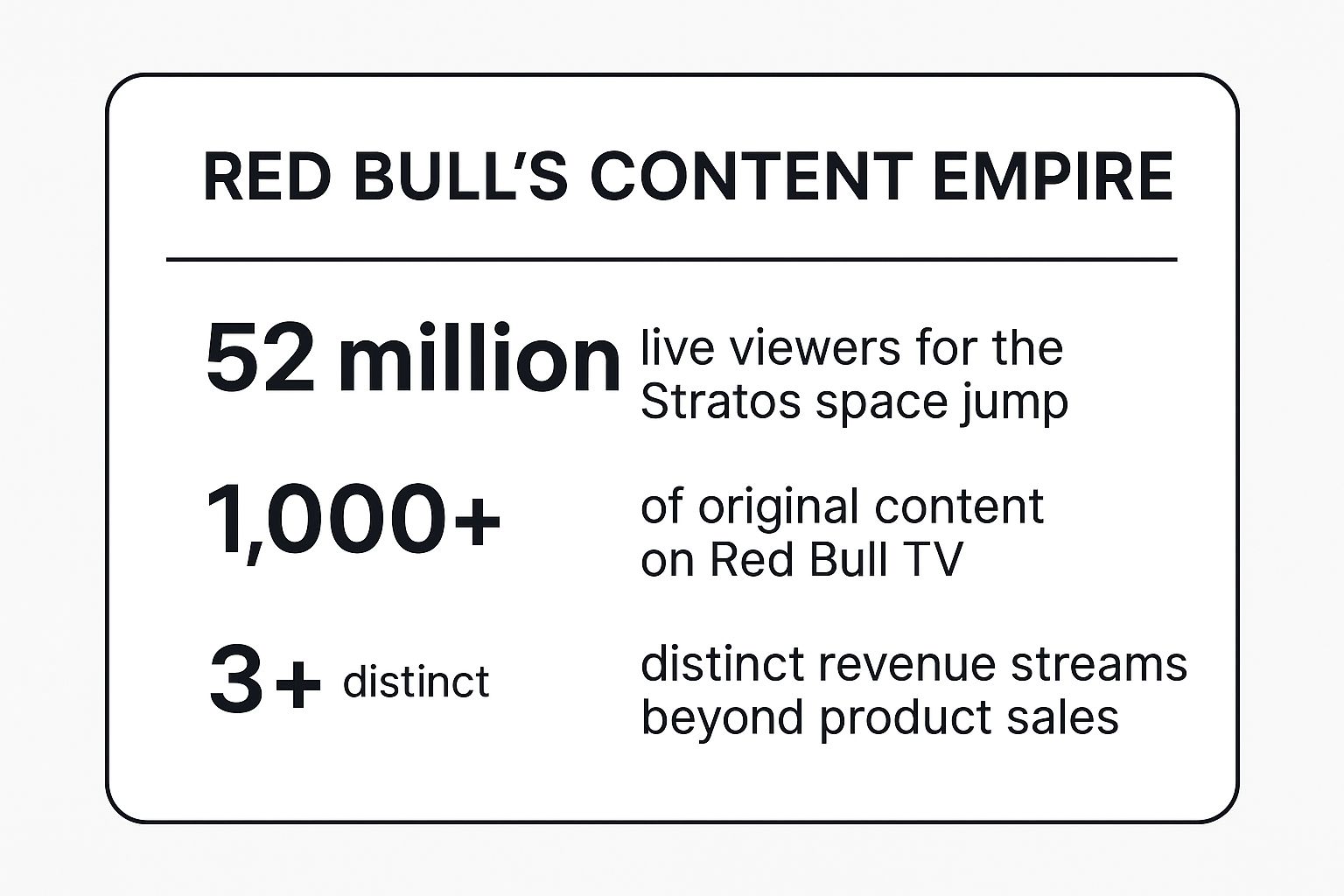
These figures show that Red Bull operates less like a beverage company and more like a diversified media corporation, generating revenue and brand loyalty far beyond product sales.
How Sight AI Streamlines This Approach
Executing a Red Bull-level strategy requires massive content volume and immediate visibility.
Sight AI’s Role:
For a brand producing daily articles, videos, and event pages, ensuring every new piece of content is indexed by Google immediately is crucial for capitalizing on trending topics and live events. Sight AI's automated indexing service submits new URLs instantly, so they can appear in search results when audience interest is at its peak. This maximizes the ROI of high-cost, time-sensitive content.
Website: https://www.trysight.ai
2. HubSpot's Educational Content Hub Strategy
HubSpot is a masterclass in turning education into a lead-generation engine. Instead of pushing their software, they created an entire ecosystem of free, high-value resources that solve the core problems of their target audience: marketers, salespeople, and customer service professionals. This approach is one of the most effective content marketing strategy examples because it builds trust and authority first, making their product the logical next step.
The strategy is built on the principle of inbound marketing, a term they coined. They attract customers by creating valuable content and experiences tailored to them, rather than interrupting them with traditional advertising. This includes comprehensive blog posts, free courses and certifications via HubSpot Academy, and powerful tools like their free CRM.
Strategic Breakdown
HubSpot's content strategy operates on a "freemium" model for information. By offering genuinely useful resources like marketing plan templates, industry benchmark reports, and free certifications, they attract millions of users. The HubSpot Blog has historically drawn millions of monthly visitors, a testament to its quality and SEO prowess.
This educational content serves a dual purpose. First, it solves a user's immediate problem, establishing HubSpot as a trusted expert. Second, it naturally showcases the need for a more robust solution, which their software provides. A user who downloads a free email marketing template is a prime candidate for HubSpot's Marketing Hub. This seamless transition from education to product is the core of their success.
Actionable Takeaways
How can you apply HubSpot's educational model to your business?
Solve Problems, Don't Sell Products: Identify the most pressing questions and challenges your audience faces. Create definitive, best-in-class content that answers those questions, such as detailed guides, free tools, or templates.
Gate High-Value Content Strategically: Offer a significant amount of your content for free to build trust and attract traffic. Reserve lead capture forms for your most valuable, in-depth resources like ebooks, webinars, or comprehensive courses.
Build a Knowledge Hub: Centralize your educational content into a well-organized blog or resource center. This not only improves user experience but also creates a powerful SEO asset that accumulates authority over time.
How Sight AI Streamlines This Approach
An educational content strategy relies on publishing a large volume of high-quality, evergreen, and timely content to capture organic search traffic.
Sight AI’s Role:
For a brand executing a HubSpot-style strategy, publishing multiple blog posts, guides, and landing pages daily is common. Waiting for Google to organically discover and index this content can mean weeks of lost traffic and leads. Sight AI's API-driven service submits every new piece of educational content for indexing immediately, so it can start ranking sooner. This accelerates the ROI of your content creation efforts significantly.
3. Dove's Real Beauty Campaign Storytelling
Dove shifted the entire beauty industry's conversation by anchoring its content marketing in a powerful social mission rather than product features. The "Campaign for Real Beauty" is one of the most enduring content marketing strategy examples because it connected a brand to a deeply emotional, universal human experience: self-esteem. It demonstrates how purpose-driven storytelling can build a fiercely loyal community around a brand’s values.

The strategy was to challenge narrow, unrealistic beauty standards by celebrating real women. Instead of using models, Dove featured women of diverse ages, ethnicities, and body types, creating content that resonated on a personal level and sparked global conversations about body positivity.
Strategic Breakdown
Dove's campaign transcends traditional advertising by creating viral social experiments and educational resources. The "Real Beauty Sketches" video, which has been viewed over 180 million times, is a prime example. The video highlighted the gap between how women see themselves and how others see them, creating a profound emotional impact that generated massive organic reach.
This mission is backed by tangible action. The Dove Self-Esteem Project provides educational tools for parents, teachers, and youth leaders, having reached over 82 million young people to date. This commitment proves their mission is not just a marketing angle but a core part of the brand's identity, building deep trust and authenticity.
Actionable Takeaways
How can you leverage authentic, mission-driven storytelling?
Align with an Authentic Cause: Identify a social cause or value that genuinely connects with your brand’s mission and audience. Authenticity is key; consumers can spot a disingenuous effort immediately.
Feature Your Customers' Stories: Use real people and their genuine experiences as the foundation of your content. This customer-centric approach builds trust and relatability far more effectively than polished ad copy. If you're looking to enhance your brand's narrative, learning more about SEO copywriting best practices can help you craft more compelling stories.
Back Words with Action: Don't just talk about your values; demonstrate them. Create programs, initiatives, or partnerships that support your mission and prove your brand's commitment beyond just selling products.
How Sight AI Streamlines This Approach
A mission-driven campaign relies on consistent, timely communication across a blog, social channels, and dedicated resource pages.
Sight AI’s Role:
When a brand like Dove launches a new video or publishes new resources, that content needs to be discoverable quickly to capture public conversation. Sight AI submits every new article, landing page, and educational guide to search engines for fast indexing, helping the campaign gain momentum and rank for relevant keywords when it matters most.
4. Airbnb's User-Generated Travel Stories
Airbnb built its global brand not on ads about empty rooms, but on the authentic stories of the people who inhabit them. By turning its community of hosts and guests into its primary storytellers, Airbnb mastered user-generated content (UGC) to build unparalleled trust and desire. This is a brilliant content marketing strategy example because it leverages authenticity to market experiences, not just accommodations.
The strategy is rooted in the idea of "Belong Anywhere." Instead of selling hotel features, Airbnb sells unique, human-centric travel experiences. They do this by curating and amplifying the photos, stories, and guides created by the very people using their platform, turning customers into their most powerful marketing assets.
Strategic Breakdown
Airbnb’s genius lies in making content creation seamless and aspirational for its users. The "Belong Anywhere" campaign moved away from traditional advertising by featuring real hosts and guests, showcasing their personal stories and unique homes. This built an emotional connection that polished, corporate content could never achieve.
Their Instagram account, with over 5 million followers, acts as a global travel magazine curated largely from guest and host photos. Their "Airbnb Experiences" are promoted through content from the local experts who run them, while host-written travel guides provide insider tips that feel more like a friend's recommendation than a marketing piece. This ecosystem of trust-based content inspires wanderlust and drives bookings organically.
Actionable Takeaways
How can you build a powerful UGC engine like Airbnb?
Make Sharing Effortless: Create simple submission processes, clear calls-to-action, and dedicated hashtags. The easier it is for users to share, the more content you will receive.
Curate and Elevate: Don't just accept all content. Establish quality standards and curate the best submissions. Highlighting top contributors rewards them and sets a benchmark for others.
Integrate UGC Across All Channels: Feature user stories on your website, in email newsletters, on social media, and even in paid ad campaigns. This reinforces authenticity and shows your community they are valued.
By placing real human experiences at the forefront, Airbnb not only populates its marketing channels with endless, low-cost content but also builds a powerful flywheel of social proof that consistently attracts new users and helps drive more website traffic.
How Sight AI Streamlines This Approach
A UGC-heavy strategy means a constant stream of new content pages, from featured stories to host-written neighborhood guides.
Sight AI’s Role:
For a platform that relies on a high volume of new, user-generated pages, fast indexing is vital. Sight AI submits every new guide, featured story, or experience page the moment it's published, so authentic content can start ranking and attracting organic traffic right away.
5. Buffer's Transparency and Behind-the-Scenes Content
Buffer built its brand on a foundation of radical transparency, transforming internal business operations into a powerful content engine. Instead of just writing about social media marketing, they shared everything from their revenue dashboard to employee salaries. This is one of the most effective content marketing strategy examples for building trust and community in a crowded market.
The strategy hinges on one core principle: authenticity attracts and retains an audience. By openly sharing their journey, including successes, failures, and internal data, Buffer established itself as a go-to resource not just for social media tips but for insights into building a modern, people-first company.
Strategic Breakdown
Buffer’s transparency wasn’t a gimmick; it was a core value woven into their content. Their "Open Blog" became famous for publishing detailed posts on company equity, diversity statistics, and the reasoning behind tough business decisions. Their public salary formula and transparent salary spreadsheet went viral, establishing Buffer as a thought leader in progressive company culture.
This behind-the-scenes approach extended to sharing real-time business metrics via their public revenue dashboard. This level of openness demystified the startup journey for their audience of entrepreneurs and marketers, creating an incredibly strong bond. They weren't just a software provider; they were a trusted guide sharing a map of their own territory.
Actionable Takeaways
How can you leverage transparency to build a loyal audience?
Share the "Why," Not Just the "What": Don't just publish data; explain the context, the lessons learned, and the decisions behind the numbers. This turns raw information into valuable, relatable stories.
Document, Don't Create: Instead of brainstorming new content ideas from scratch, document your existing processes, challenges, and successes. This creates a natural and sustainable content pipeline.
Start Small and Be Consistent: You don't need to share everything at once. Start by sharing insights from a single marketing campaign or a failed experiment. Consistency in sharing builds trust over time.
How Sight AI Streamlines This Approach
A transparency-focused strategy generates a high volume of timely, data-rich content like monthly reports, case studies, and business updates.
Sight AI’s Role:
When a company publishes a major update or a monthly revenue report, its impact is greatest when it's discovered immediately. Sight AI submits these time-sensitive updates for fast indexing, so the content can be found via search right away, building authority and capturing interest at its peak.
6. Netflix's Data-Driven Personalized Content Strategy
Netflix revolutionized the entertainment industry by treating content not just as art, but as a data science problem. Instead of guessing what audiences want, they leverage massive amounts of viewer data to inform every decision, from commissioning new shows to personalizing the thumbnails you see. This is one of the most sophisticated content marketing strategy examples because it turns the user experience itself into a self-improving marketing engine.
The core of the strategy is hyper-personalization at scale. Netflix understands that there isn't one monolithic audience but millions of micro-audiences. By analyzing viewing habits, they can predict what content will resonate and market it with precision, ensuring the right content finds the right viewer at the right time.
Strategic Breakdown
Netflix's data-driven approach is a closed loop. They collect data on what you watch, how long you watch it, and what you search for. This data feeds algorithms that not only recommend existing titles but also inform new productions. For instance, House of Cards was commissioned partly based on data showing a crossover audience for director David Fincher, its lead actor, and the original British series.
This personalization extends to the marketing itself. The artwork for a single show like Stranger Things is not uniform; Netflix tests multiple variations. A user who watches many horror films might see a scarier, monster-focused thumbnail, while someone who prefers teen dramas might see one featuring the young cast. Netflix has publicly described artwork personalization as a meaningful driver of engagement.
Actionable Takeaways
How can you apply data-driven personalization to your content?
Analyze User Behavior: Start collecting data on how users interact with your content. Use tools like Google Analytics or heatmaps to understand which topics, formats, and headlines perform best for different audience segments.
Test in Small Increments: You don't need Netflix's budget to start personalizing. Begin by testing different email subject lines, blog post headlines, or call-to-action buttons for distinct segments of your audience.
Balance Data with Discovery: While personalization is powerful, avoid creating an echo chamber. Ensure your strategy also includes opportunities for users to discover new topics they might not have searched for directly.
This level of personalization requires a robust content creation pipeline. Discover how to use technology to scale your efforts and automate content creation to meet diverse audience needs.
How Sight AI Streamlines This Approach
A data-driven strategy often involves creating numerous niche content variations or landing pages to appeal to different audience segments.
Sight AI’s Role:
When you create dozens of personalized assets, landing pages, or blog posts targeting specific personas, each one needs to be indexed quickly to be effective. Sight AI submits every unique URL the moment it's published, so your tests gather data sooner and your targeted content becomes visible in search.
7. Patagonia's Environmental Activism Content
Patagonia has woven its core mission of environmental activism directly into its content, creating one of the most authentic content marketing strategy examples available. Instead of focusing on product features, their content champions causes, educates audiences on environmental issues, and fosters a community built on shared values. This transforms customers into advocates, not just for the brand, but for the planet itself.
The strategy is built on radical transparency and a willingness to prioritize purpose over profit. By producing content that challenges consumerism and highlights environmental crises, Patagonia builds unshakable trust among an audience that sees purchases as a form of activism.
Strategic Breakdown
Patagonia's content doesn't just talk about its values; it proves them through action and storytelling. The legendary "Don't Buy This Jacket" campaign, which ran on Black Friday 2011, urged consumers to consider the environmental cost of their purchases, yet it drove sales and cemented Patagonia's reputation as a brand that puts principles first.
This commitment is further demonstrated through long-form content like documentary films. Productions such as "DamNation" and "Artifishal" are not commercials; they are professionally produced films that tackle serious environmental issues, reaching mainstream audiences and winning awards. They also maintain "The Footprint Chronicles," a section of their website dedicated to supply chain transparency, allowing customers to trace the impact of their products.
Actionable Takeaways
How can you build a strategy around purpose-driven content?
Align Content with Core Values: Ensure your content is a genuine extension of your company's mission and is backed by concrete corporate actions, like Patagonia's 1% for the Planet pledge.
Embrace Controversy (Authentically): Taking a strong stance on important issues will resonate deeply with your target audience, even if it alienates others. Authenticity is more powerful than trying to please everyone.
Educate, Don't Just Sell: Focus on creating content that informs and empowers your audience around a shared interest or cause. This builds a relationship based on trust, which is far more valuable than a transactional one.
Patagonia’s activism and content initiatives require robust systems to handle a vast amount of information. For similar brands, exploring enterprise content management solutions can be key to maintaining consistency and impact across all channels.
How Sight AI Streamlines This Approach
A purpose-driven content strategy often involves responding to current events, publishing research, or launching advocacy campaigns that require immediate visibility.
Sight AI’s Role:
When a brand publishes an urgent call to action or a new film about a critical issue, that content needs to be discoverable quickly. Sight AI submits these timely pages for indexing upon publication, so the brand's voice is present in search results when public conversation peaks.
8. Salesforce's Trailhead Gamified Learning Platform
Salesforce flipped the traditional B2B content model by turning education into a core marketing asset. Instead of just creating whitepapers and webinars about their product, they built Trailhead, a free, gamified learning platform that trains a global workforce. This is one of the most effective content marketing strategy examples for SaaS companies because it solves a primary customer pain point: the skills gap.
The strategy is simple: empower users with valuable, career-building skills for free, and they will become product experts and brand evangelists. Trailhead teaches everything from Salesforce administration to broader business skills like agile project management, creating a loyal ecosystem of skilled professionals invested in the platform.
Strategic Breakdown
Salesforce understood that product adoption hinges on user confidence and expertise. Trailhead breaks complex topics into bite-sized, interactive modules organized into "trails." Users earn points and badges as they complete modules, creating a sense of achievement and a clear progression path from beginner to expert. This gamification makes learning motivating.
With millions of registered learners and a broad catalog of certifications, Trailhead has created a self-sustaining community. Users showcase their badges on LinkedIn, signaling expertise to employers and organically promoting Salesforce. This credentialing system has become a powerful engine for customer acquisition, retention, and advocacy, driving demand for the core product from the ground up.
Actionable Takeaways
How can you apply an educational platform strategy?
Gamify the Learning Experience: Use points, badges, and leaderboards to motivate users and encourage consistent engagement. Make learning feel like an achievement, not a chore.
Create Clear Progression Paths: Design learning content that guides users from novice to advanced levels. This builds confidence and demonstrates long-term commitment to their professional growth.
Foster a Community Hub: Build forums, user groups, and events around your educational content. A strong community increases retention and turns learners into advocates who support each other.
How Sight AI Streamlines This Approach
An educational platform like Trailhead constantly adds new courses, modules, and certification pages. Ensuring this new content is found quickly is essential for engagement and program growth.
Sight AI’s Role:
When a new course or certification path is released, users are eager to start. Sight AI’s automated indexing submits these new URLs immediately, helping them appear in search results for people actively looking for new skills.
Content Marketing Strategy Examples Comparison
| Strategy | Implementation Complexity | Resource Requirements | Expected Outcomes | Ideal Use Cases | Key Advantages |
|---|---|---|---|---|---|
| Red Bull's Extreme Sports Content | High - requires media production & sponsorship | Multi-million dollar annual investment | Strong brand identity, multiple revenue streams | Lifestyle & consumer brands with large budgets | High engagement, entertainment brand positioning |
| HubSpot's Educational Content Hub | Medium - requires consistent expert content | Continuous content creation & SEO effort | Lead generation, thought leadership, SEO growth | B2B SaaS companies aiming for inbound leads | Scalable, measurable, builds trust |
| Dove's Real Beauty Campaign | Medium - long-term storytelling & advocacy | Ongoing content production & social research | Strong emotional connection, brand differentiation | Brands focusing on social impact & authenticity | Emotional engagement, loyal community |
| Airbnb's User-Generated Travel Stories | Low to medium - community-driven, needs management | Community management & curation | Authentic peer recommendations, diverse global content | Platforms leveraging user stories and trust | Low production cost, scalable, authentic |
| Buffer's Transparency Content | Medium - requires open internal sharing | Consistent content & organizational buy-in | Exceptional trust, thought leadership, strong loyalty | Transparent companies & startups | Builds authenticity, unique PR value |
| Netflix's Data-Driven Personalization | High - needs advanced data science & tech | Billions in data infrastructure & content | Increased engagement, reduced churn, personalized UX | Large-scale digital platforms & streaming | Precise targeting, high ROI on content investment |
| Patagonia's Environmental Activism | Medium to high - activism with consistent messaging | Authentic commitment & partnerships | Loyal community, strong brand purpose | Brands with strong environmental/social mission | Passionate followers, earned media |
| Salesforce's Trailhead Gamified Learning | High - platform development & content updates | Significant investment in tech & education | Skilled user base, product adoption, qualified leads | SaaS companies focusing on user training | Community building, measurable learning outcomes |
Sample Content Marketing Strategy Template
Every example above can be reduced to the same one-page plan. Use this sample content strategy as a starting point and fill each line before producing any content:
Business objective: One measurable goal tied to revenue, e.g. "Generate 150 demo requests per quarter from organic content."
Audience and job-to-be-done: Who you serve and the problem they need solved, independent of your product (HubSpot: "marketers who need to plan campaigns").
Core content pillar(s): Two to four topic clusters you can credibly own, each mapped to a set of target keywords and questions.
Signature format: The asset type you will be known for: documentaries (Red Bull), free courses (Salesforce), templates (HubSpot), open data (Buffer).
Distribution plan: Owned hub (blog, resource center), search (Google and AI answer engines), email, and one or two social channels. Assign a cadence to each.
Production workflow: Briefing, drafting, expert review, publishing, indexing, and refresh cycles, with an owner for each step.
KPIs: Leading indicators (impressions, rankings, AI citations, engagement) and lagging indicators (leads, pipeline, retention).
Search visibility today extends beyond blue links. If you want your content cited in ChatGPT, Perplexity or Google's AI Overviews, read our guide on generative engine optimization (GEO), and use a framework for measuring AI visibility performance alongside traditional rankings.
From Strategy to Execution: Building Your Content Engine
From Red Bull's adrenaline-fueled media empire to Salesforce's gamified educational platform, each case study reveals universal truths about winning with content. The success of these brands wasn't accidental; it was built on strategic principles any organization can adapt.
The common thread is a relentless focus on audience value. HubSpot doesn't just sell software; it teaches inbound marketing. Patagonia doesn't just sell apparel; it champions environmental activism. They built authority by becoming an indispensable resource, a source of entertainment, or a leader in a meaningful conversation.
Core Pillars of a Winning Content Strategy
Pillar 1: Audience-Centric Value: Your content must serve a purpose for your audience that exists independently of your product: solving a problem (HubSpot), providing inspiration (Airbnb), or aligning with their values (Dove, Patagonia). Before creating any piece, ask: "What value does this provide to our target audience?"
Pillar 2: Strategic Consistency: Sporadic content efforts yield sporadic results. Brands like Buffer built trust through consistent publishing. Consistency creates audience expectations, builds habitual engagement, and signals to search engines that you are a reliable source. It requires a repeatable, scalable workflow.
Pillar 3: Uncompromising Quality and Authenticity: Quality isn't just polished production; it's authenticity and depth. Netflix ensures relevance by personalizing content, while Buffer's transparency creates an authentic connection. Your content must be well-researched, genuinely helpful, and reflective of your brand's true voice.
Bridging the Gap Between Vision and Reality
Understanding these pillars is the first step, but execution is where most strategies falter. Building a content engine requires systems to bring ideas to life efficiently and ensure they get seen.
The biggest hurdles are scale and speed. How do you maintain a high publishing cadence without sacrificing quality? And once published, how do you ensure content gets indexed and ranked quickly to start generating ROI? The ability to streamline creation and accelerate visibility is what separates stagnant blogs from high-growth content platforms.
Frequently asked questions
What is an example of a content marketing strategy?
HubSpot's educational hub is a classic example: the company publishes free guides, templates, courses and a free CRM that solve marketers' everyday problems, then converts that trust into software customers. The strategy has a clear objective (inbound leads), a defined audience, owned distribution (its blog and academy) and measurable KPIs. See the seven other breakdowns above for B2C, UGC and purpose-driven alternatives.
What should a content marketing plan include?
A complete plan includes a business objective, audience definition, content pillars mapped to keywords, a signature format, a distribution plan with cadence, a production workflow with owners, and KPIs. The sample content marketing strategy template above lays out each component in seven steps you can copy into your own planning document.
What is the difference between content strategy and content marketing strategy?
Content strategy covers how all of an organization's content is planned, created, governed and maintained, including product documentation and UX copy. Content marketing strategy is the subset focused on attracting and converting an audience: which topics to publish, for whom, through which channels, and how success is measured against marketing goals like traffic, leads and revenue.
How do small businesses copy these strategies without a big budget?
Pick the low-cost models: Buffer's transparency (document what you already do), Airbnb's UGC (curate customer stories), and HubSpot's education (answer your customers' top 20 questions in depth). Skip tentpole productions like Red Bull's until you have a proven channel. Focus on one pillar, publish consistently, and make sure every page is indexed and tracked.
How do content marketing strategies need to change in 2025?
Search increasingly happens inside AI answer engines, so content must be structured to be cited, not just ranked: clear direct answers, original data, and strong entity signals. Teams should track AI visibility alongside Google rankings, publish faster, and refresh existing content regularly so it stays accurate and competitive.
Ready to turn your strategic vision into measurable results? Sight AI bridges the gap between content creation and organic growth by using AI to generate high-quality, SEO-optimized articles and getting them indexed by Google within 48 hours. Stop waiting weeks for your content to get noticed and start building your content engine with the speed and scale required to dominate your niche. Visit Sight AI to see how you can accelerate your content marketing today.