Something fundamental has shifted in how people find information. Instead of scanning a page of blue links and clicking through to websites, a growing number of users now type a question into ChatGPT, Perplexity, or Google's AI Overviews and receive a synthesized, conversational answer in seconds. No clicking required. No website visit logged. Just an answer, delivered directly.
This raises a critical question for every marketer, founder, and SEO strategist: if your brand isn't being mentioned in those AI-generated responses, are you effectively invisible to a significant and growing segment of your audience?
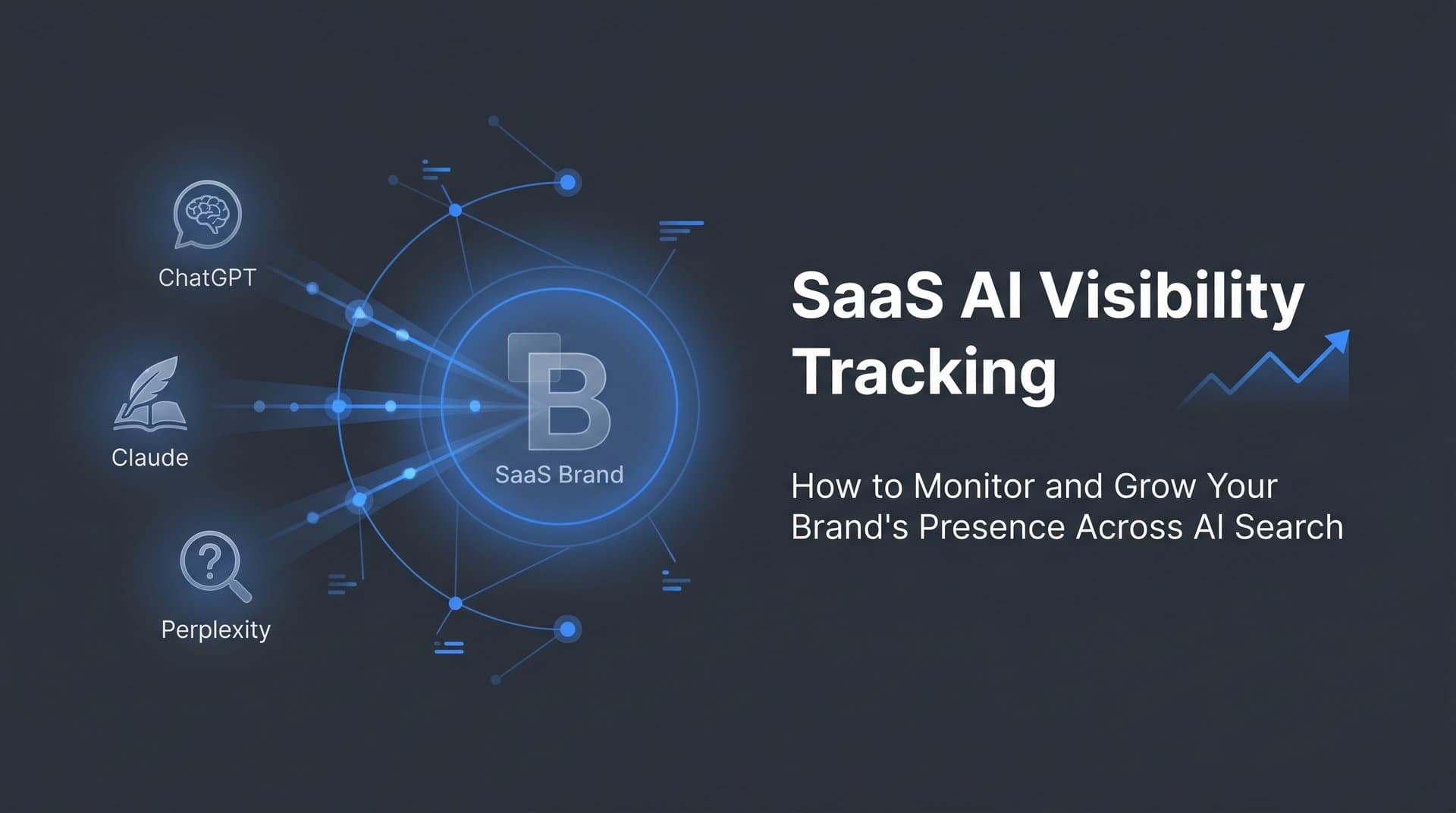
Generative search visibility tracking is the discipline built to answer that question. At its core, it's the practice of systematically monitoring when, how, and in what context AI models reference your brand, products, or content across platforms like ChatGPT, Claude, Perplexity, and Google's AI Overviews. It's not a replacement for traditional SEO measurement. It's the missing layer that traditional tools simply cannot provide.
This article breaks down everything you need to understand about this emerging discipline: why it matters now, what it actually tracks, how to interpret the data it produces, and how to turn those insights into a content strategy that builds measurable AI presence over time. Whether you're just becoming aware of the gap or you're ready to build a formal tracking workflow, this guide covers the full picture.
Why Traditional SEO Metrics Leave You Flying Blind
For years, the core metrics of search visibility were relatively straightforward: keyword rankings, organic traffic, click-through rates, and impressions. These metrics were built on a simple assumption: users search, see a list of results, click a link, and land on a website. The entire measurement infrastructure of SEO was designed around that journey.
Generative AI search breaks that assumption entirely.
When a user asks ChatGPT "What's the best project management software for remote teams?" or queries Perplexity with "How do I reduce customer churn in SaaS?", they often receive a complete, synthesized answer without ever visiting a website. There's no click to track. There's no impression on a SERP. The user got what they needed, and your analytics platform recorded nothing.
This is the zero-click problem, and AI-powered search has amplified it to a new level. Even if your website ranks number one organically for a relevant keyword, that ranking offers no guarantee your brand will appear in the AI-generated answer for a related query. The two systems operate on different logic. Traditional search ranks pages. Generative AI synthesizes information from multiple sources and constructs a response, often without surfacing the original URLs prominently or at all. Understanding AI replacing Google search traffic is essential for grasping the scale of this shift.
The result is a new and significant blind spot. A brand could be performing well by every traditional SEO metric while simultaneously being absent from the AI-generated answers that are shaping how users understand their options, make decisions, and form brand preferences. You wouldn't know it from your rank tracker. You wouldn't see it in Google Search Console. The gap is invisible to legacy tools.
This is precisely where generative search visibility tracking enters the picture. It's a new category of measurement designed to complement your existing SEO stack by answering the questions traditional tools can't: Is your brand being mentioned when AI models respond to relevant prompts? How frequently? In what context? And how does that compare to your competitors? Brands that want to understand this landscape should explore dedicated AI search visibility tools built for this exact purpose.
Think of it as adding a new instrument to your measurement dashboard. Rank tracking tells you where you appear in traditional search results. Generative search visibility tracking tells you whether you exist in AI-generated answers at all. Both matter. But only one of them reflects where search behavior is rapidly heading.
The brands that recognize this shift early and build measurement practices around it will have a meaningful advantage. Those that continue relying solely on traditional SEO metrics risk optimizing for a version of search that is increasingly incomplete.
What Generative Search Visibility Actually Tracks
Understanding what generative search visibility tracking involves requires breaking it down into its core components. This isn't a single metric. It's a multi-dimensional measurement practice that captures several distinct signals about your brand's presence in AI-generated responses.
Prompt Monitoring: The foundation of any tracking system is the set of prompts being monitored. These are the questions and queries that real users are likely to ask AI models in contexts relevant to your brand, product category, or industry. Identifying the right prompts is itself a strategic exercise. You're mapping the conversational landscape where your brand should ideally appear. Learning about prompt tracking for brand mentions can help you build a more effective monitoring foundation.
Mention Detection: Once prompts are defined, tracking tools systematically send those prompts to AI models and analyze the responses for brand references. This includes direct mentions of your brand name, references to your products, and in some cases, descriptions of capabilities or approaches that align with what you offer even without explicit naming.
Sentiment Analysis: A mention isn't inherently positive. Generative search visibility tracking includes analyzing the framing and tone of how your brand is referenced. Is the AI describing your product as a market leader? A budget option? A tool with limitations? Sentiment polarity matters because AI-generated answers can shape user perception before a prospect ever visits your website.
Competitive Benchmarking: Perhaps the most strategically valuable dimension is understanding share of voice. When your brand isn't mentioned in a relevant AI response, who is? Competitive benchmarking within AI answers reveals which brands are winning the generative search landscape and what content or authority signals may be driving that presence.
Technically, tracking tools work by sending structured prompts to AI model APIs or interfaces, capturing the full text of responses, and running analysis pipelines to extract brand references, sentiment indicators, and contextual signals. This process needs to happen repeatedly over time, and here's why: AI model outputs are non-deterministic. The same prompt can yield meaningfully different responses across sessions, models, or even time periods as training data updates. A single query is a snapshot, not a trend. Reliable insight requires repeated measurement to surface patterns that hold up across the natural variation in AI outputs.
This is also what distinguishes generative search visibility tracking from traditional SERP monitoring. Traditional tools check a fixed ranking position for a keyword. Generative tracking has to account for probabilistic outputs, multiple AI platforms with different source preferences, and the fact that "visibility" in an AI answer is qualitative as well as quantitative. Your brand might be mentioned in a response but framed as a secondary option. That's different from being the first recommendation, and good tracking systems capture that distinction. Understanding how AI models mention brands is key to interpreting these nuances correctly.
Platforms like Sight AI are built around this multi-dimensional approach, monitoring brand mentions across multiple AI models simultaneously and providing structured data on mention frequency, sentiment, and competitive positioning. The goal is to turn what was previously an unobservable black box into a measurable, actionable signal.
The Metrics That Actually Tell You Something Useful
Data without interpretation is just noise. Once you're tracking generative search visibility, you need a framework for reading what the numbers mean and what they're telling you to do.
AI Visibility Score: This is a composite metric that aggregates your brand's overall presence across tracked prompts and AI platforms. Think of it as an index that captures both frequency and quality of mentions. A rising score generally indicates improving brand authority in AI-generated content. A declining score warrants investigation. Dedicated AI visibility analytics dashboards can help you visualize and interpret these composite scores effectively.
Mention Frequency: How often does your brand appear across the set of prompts you're monitoring? This is the most direct measure of raw presence. Tracking this over time reveals trends. A steady decline in mention frequency often signals that competitors are publishing more authoritative content that AI models are beginning to favor, or that your existing content is losing relevance as training data evolves.
Sentiment Polarity: Are mentions positive, neutral, or negative? This dimension can surface reputation issues you might not be aware of. If AI models are consistently framing your product with caveats or limitations, that framing is reaching users at a critical moment in their decision-making process. Negative sentiment shifts in AI answers can sometimes reflect how your brand is being discussed in the broader web content that models draw from. Investing in brand sentiment tracking software helps you catch these shifts before they compound.
Share of Voice in AI Answers: Across your tracked prompts, what percentage of responses mention your brand versus competitors? This is your competitive position in the generative search landscape. A brand with strong traditional SEO rankings but low AI share of voice has a clear strategic gap to address.
Prompt Coverage: Of all the prompts relevant to your brand, how many actually trigger a mention? A brand might score well on the prompts where it appears but have large swaths of relevant query territory where it's entirely absent. Prompt coverage reveals the breadth of your AI visibility, not just its intensity.
One of the most important principles in reading this data is the multi-platform imperative. Different AI models draw on different sources, apply different weighting to authority signals, and produce different brand narratives. A brand that appears prominently in ChatGPT responses might be largely absent from Perplexity or Claude. Tracking across a single model gives you a partial view at best. Comprehensive generative search visibility tracking requires monitoring across the major platforms simultaneously, because each one represents a distinct audience and a distinct set of algorithmic preferences.
Trend analysis over time is where the real strategic value emerges. A single data point tells you your current state. A trend line tells you where you're headed and whether your content investments are working.
Turning Visibility Gaps into a Content Strategy That Works
Here's where generative search visibility tracking stops being a measurement exercise and starts being a growth engine. The data it produces is most valuable when it directly informs what content you create next.
Visibility gaps are your roadmap. A visibility gap exists when there's a prompt where your brand should logically appear given what you offer, but doesn't. These gaps represent missed opportunities in the AI-generated conversation happening around your category. Each gap is essentially a content brief: a specific knowledge area where AI models lack sufficient authoritative content from your brand to reference you. If you're wondering why your competitors show up instead, this guide on competitors ranking in AI answers explains the dynamics at play.
This is where GEO (Generative Engine Optimization) connects directly to tracking. GEO is the practice of creating and structuring content so that AI models are more likely to reference it when generating responses. The visibility tracking data tells you which gaps to prioritize. The GEO content strategy tells you how to fill them. Exploring the best generative engine optimization tools can accelerate your ability to execute on this strategy.
Several content characteristics consistently improve the likelihood of AI models referencing your content. Topical depth matters: a comprehensive, well-structured article that covers a subject thoroughly gives AI models more material to draw from than a thin overview. Authoritative sourcing matters: content that cites credible sources and demonstrates expertise aligns with the signals AI models use to assess reliability. Structured clarity matters: content organized with clear headings, defined concepts, and logical flow is easier for AI systems to parse and extract from.
The feedback loop this creates is powerful. You identify a visibility gap through tracking. You produce a GEO-optimized article targeting that specific knowledge area. You re-measure after a period of time to see whether AI models have begun referencing that content. If yes, you've successfully moved the needle. If not, you refine the approach and iterate.
This cycle replaces guesswork with data-driven iteration. Instead of publishing content and hoping it influences AI outputs, you're systematically targeting known gaps, measuring outcomes, and adjusting based on results. It's the same logic that made keyword-driven SEO powerful, applied to the generative search layer.
One additional factor worth noting: content discoverability affects how quickly AI models that use real-time retrieval can access new content. Faster indexing through protocols like IndexNow means that newly published content gets discovered sooner, potentially accelerating the time between publication and AI model pickup. In a landscape where competitive dynamics shift quickly, that speed advantage matters.
Building a Practical Generative Search Visibility Workflow
Understanding the theory is one thing. Building a repeatable workflow that your team can execute consistently is another. Here's how to structure a generative search visibility tracking practice from the ground up.
1. Identify priority prompts: Start by mapping the questions your target audience is likely to ask AI models in contexts relevant to your brand. Think about product category queries, problem-solution queries, comparison queries, and industry knowledge queries. This prompt set becomes the foundation of your tracking program. Aim for breadth across your key topics, not just branded queries.
2. Establish a baseline: Before you can measure progress, you need to know where you stand. Run your prompt set across the major AI platforms (ChatGPT, Claude, Perplexity, Gemini, and others relevant to your audience) and capture your initial visibility scores, mention frequency, sentiment, and competitive share of voice. This baseline is your starting point for all future comparison. A comprehensive guide on how to track brand in AI search can help you structure this initial measurement phase.
3. Audit content gaps: Map your baseline visibility data against your existing content library. Where are the prompts where you're absent? What topics do those prompts cover? Which competitors are filling those gaps? This audit translates raw visibility data into a prioritized content backlog.
4. Produce and publish GEO/SEO-optimized content: Create content specifically designed to address the identified gaps. Apply GEO best practices: topical depth, authoritative sourcing, clear structure, and comprehensive coverage of the subject matter. Publish and index promptly, using automated indexing tools where available to accelerate discovery. Understanding search engine indexing optimization ensures your new content enters the discovery pipeline as quickly as possible.
5. Re-measure and iterate: After a meaningful period (typically several weeks to a couple of months, depending on the cadence of AI model updates), re-run your tracking to measure changes in visibility. Did mention frequency increase for the targeted prompts? Did sentiment improve? Use these results to refine your approach and identify the next set of gaps to address.
Automation makes this workflow significantly more scalable. AI-powered content generation tools can accelerate the production of GEO-optimized articles, while automated indexing ensures new content enters the discovery pipeline quickly. Platforms that combine visibility tracking, content generation, and indexing in a single workflow reduce the coordination overhead that would otherwise slow down the iteration cycle.
On the team ownership question: generative search visibility tracking sits at the intersection of SEO, content strategy, and brand management. SEO leads are often best positioned to own the technical tracking and data interpretation. Content strategists translate gap analysis into editorial priorities. Brand managers should be involved in sentiment monitoring, since AI-generated framing has direct implications for brand perception. Review cadence should be at minimum monthly, with weekly check-ins during active content campaigns to catch early signals of impact.
Mistakes That Undermine Your AI Visibility Program
Even with the right tools and intentions, there are several common pitfalls that can make a generative search visibility tracking program far less effective than it should be.
Treating it as a vanity metric: AI visibility scores are only meaningful if they connect to real business outcomes. A rising mention frequency that doesn't correlate with qualified traffic, pipeline growth, or brand authority improvements is worth investigating. Build the habit of connecting your AI visibility metrics to downstream outcomes so the program remains grounded in business impact, not just measurement for its own sake. Learning how to drive organic traffic from AI search helps you bridge the gap between visibility metrics and tangible results.
Optimizing for a single AI model: The generative search landscape is genuinely fragmented. ChatGPT, Perplexity, Claude, Gemini, and others each have distinct source preferences, retrieval behaviors, and user bases. A strategy that focuses exclusively on one platform leaves significant visibility on the table and creates a false sense of security. Your audience is distributed across these platforms, and your tracking should be too.
Relying on one-time audits: AI model behavior is not static. Training data updates, retrieval algorithm changes, and shifts in how models weight authority signals mean that a snapshot taken today may not reflect reality in three months. Generative search visibility tracking only produces actionable trend data when it's done consistently over time. One-time audits are useful for establishing a baseline, but they cannot substitute for ongoing measurement.
Ignoring competitive context: Your AI visibility score doesn't exist in isolation. A stable score while competitors are rapidly gaining mentions means you're losing ground in relative terms. Always interpret your visibility data in the context of competitive share of voice, not just absolute metrics.
Your Next Move in the AI Search Era
Generative search visibility tracking has moved from an experimental concept to a genuine strategic necessity. As AI-powered search experiences continue to reshape how users discover products, evaluate options, and form brand preferences, the brands that measure and optimize their presence in these environments will have a compounding advantage over those that don't.
The core takeaway is straightforward: brands that monitor their AI presence, systematically identify the gaps where they're absent, and create authoritative content to fill those gaps will capture audiences that traditional SEO alone can no longer reach. The measurement infrastructure for this discipline now exists. The content strategies that make it work are well-defined. The feedback loop between tracking and optimization is actionable and repeatable.
What's left is execution. And that starts with visibility into where you currently stand.
Stop guessing how AI models like ChatGPT and Claude talk about your brand. Get visibility into every mention, track content opportunities across the prompts that matter to your audience, and automate your path to organic traffic growth. Start tracking your AI visibility today and see exactly where your brand appears, how it's framed, and what content moves the needle across the top AI platforms shaping your industry.