Open any AI assistant right now and ask it to recommend the best tool in your category. Go ahead. There's a good chance your competitors' names just appeared in that response, and yours didn't. That's not a coincidence, and it's not random luck. It's the result of specific, learnable signals that AI platforms use to decide which brands deserve to be named and which ones get left out entirely.
For marketers and founders, this represents one of the most significant shifts in brand discovery since Google's algorithm updates reshaped organic search. The difference is that most brands don't yet realize it's happening. They're investing in SEO, running paid campaigns, and building social presence, while a growing share of their potential customers are bypassing search engines entirely and asking AI assistants for recommendations directly.
The good news: understanding how AI platforms choose brands is not a matter of cracking a black box. These systems follow patterns that are measurable, optimizable, and, with the right strategy, genuinely winnable. This article breaks down the core signals that determine AI visibility, from content authority and third-party validation to technical discoverability and prompt-context relevance, so you can start building a strategy that puts your brand in the answer.
The Hidden Selection Process Behind Every AI Recommendation
When someone asks ChatGPT to recommend a project management tool or asks Perplexity for the best AI visibility tracker, there's no real-time search happening in the traditional sense. What looks like a recommendation is actually the output of a probabilistic process, one where the model draws on patterns encoded during training to surface brands it associates most strongly with the relevant category and context.
This distinction matters enormously for how you approach optimization. Large language models like GPT-4 and Claude are trained on massive corpora of web content. Brand mentions in that training data shape how strongly the model associates a brand with a given category, use case, or attribute. The more frequently a brand appears in relevant, authoritative contexts across the training corpus, the higher the implicit weight assigned to that brand when a matching query comes in.
But not all AI platforms work the same way. Retrieval-augmented generation (RAG) models like Perplexity operate differently: they pull from live web sources at query time, layering real-time retrieval on top of their base model. This means Perplexity's recommendations are influenced by what's actually indexed and discoverable on the web right now, not just what was present during a training run months ago. For brands targeting RAG-based platforms, real-time indexability becomes a critical factor. For pure LLM platforms, the emphasis shifts to building long-term content presence and third-party citation depth.
Brand selection in these systems is probabilistic, not deterministic. There's no ranked list sitting inside a model that says "Brand A is number one in this category." Instead, the model weights signals like citation frequency across independent sources, the authority of those sources, topical consistency across a brand's content footprint, and the alignment between a brand's described attributes and the intent of the prompt. These weighted signals combine to produce something like an implicit trust score, and that score determines whether your brand gets named or not.
The implication for marketers is significant. You're not optimizing for a single algorithm with published ranking factors. You're building a pattern of presence across a wide range of signals that, taken together, tell AI systems: this brand belongs in this conversation. The sections that follow break down exactly what those signals are and how to strengthen them.
Content Authority: Depth Over Density
If you've spent time in SEO, you already understand topical authority. The idea that covering a subject comprehensively across multiple pieces of content signals expertise to search crawlers is well established. The same principle applies to AI visibility, but with a meaningful difference in how it's weighted.
Traditional SEO rewards keyword density, metadata optimization, and backlink profiles. AI models, by contrast, weight depth and specificity more heavily. A piece of content that thoroughly defines a concept, explains its mechanics, addresses common questions, and contextualizes it within a broader category is far more likely to be extracted and encoded by an AI training pipeline than a keyword-stuffed page that covers the surface level of a topic.
Structure matters just as much as depth. AI models parse content by mapping it to patterns they recognize: definitions, comparisons, step-by-step explanations, clearly labeled sections. Content with clean headings, logical flow, and explicit answers to specific questions maps more cleanly to how LLMs encode information. Think of it this way: if your content could be turned into a reliable FAQ or a concise explainer without losing meaning, it's well-positioned for AI extraction. If it requires a human to interpret the subtext, it's likely to be passed over.
Publishing frequency and freshness add another layer, particularly for RAG-based platforms. Brands that publish consistently in their category signal ongoing relevance. Brands with stale content or thin site architecture are systematically deprioritized in AI-generated recommendations because they appear, to the system, as less active participants in the category conversation.
The practical takeaway: build a content library that covers your category from multiple angles. Publish explainers, comparisons, use-case guides, and definitional pieces that collectively establish your brand as a consistent, authoritative voice on the topics your audience is asking AI about. Each piece of content is a signal. The cumulative pattern of those signals is what earns you a place in AI-generated recommendations.
Third-Party Validation: The Off-Site Signals AI Models Trust Most
Your own website is a starting point, but it's not where AI models place their highest trust. The signals that carry the most weight in brand selection are the ones that come from independent, authoritative third-party sources. Think of it as the AI equivalent of editorial endorsement.
Industry publications, review aggregators, analyst reports, and curated listicles are heavily represented in AI training data. When your brand is mentioned in these sources in a relevant, positive or neutral context, it reinforces the association between your brand and your category in the model's implicit weighting. This functions similarly to how backlinks work in traditional SEO, but the emphasis is less on the raw number of mentions and more on the editorial context surrounding them. A detailed mention in a respected industry publication carries more weight than a passing reference in a low-authority directory.
Brand co-occurrence is a particularly important concept here. When your brand name appears alongside category-defining terms across multiple independent sources, the AI model builds a stronger association between your brand and that category. If you're in the AI visibility tracking space and your brand consistently appears alongside terms like "AI brand monitoring," "GEO optimization," and "prompt tracking" in third-party content, the model learns to surface you when those concepts come up in a query.
User-generated content deserves special attention. Forums, community platforms, and Q&A sites where real people recommend specific brands in response to genuine questions are disproportionately represented in AI training data. This makes sense: these are the sources that AI systems recognize as authentic, unsponsored signals of real-world usage. A thread where multiple users independently recommend your tool in response to a specific problem is a powerful visibility signal, often more so than a polished press release.
The strategic implication is clear. Off-site authority building is not optional for AI visibility. Earning mentions in industry publications, being included in relevant listicles, generating genuine community discussion, and appearing in analyst coverage all contribute to the third-party validation layer that AI models weight heavily when choosing which brands to recommend.
Prompt Context and Query Framing: How the Question Shapes the Answer
Here's something that surprises most marketers when they first encounter it: AI platforms don't return the same brand recommendations for every query in a category. The specificity, intent, and framing of a prompt dramatically shifts which brands get surfaced. Optimizing for broad category visibility is not enough.
Consider the difference between "best project management tool" and "best project management tool for remote engineering teams under 20 people." These prompts will likely surface different brands, because the model is matching not just to category but to the specific attributes and use cases described in the query. Brands that have published content directly addressing those specific scenarios have a meaningful advantage over brands that only address the category in general terms.
Long-tail, problem-specific prompts are particularly important for emerging or niche brands. A brand that doesn't rank for the broad category term may still surface prominently for highly specific queries if its content library addresses those specific use cases in depth. This is one of the more actionable insights in AI visibility strategy: you don't need to beat the category leader on every prompt. You need to own the specific prompts that your target audience is actually using.
Which brings up the core intelligence gap that most brands are not yet addressing: they don't know which prompts their audience is using, and they don't know which of those prompts currently surface competitors instead of them. This is a measurable problem. By systematically testing prompts across AI platforms and tracking which brands appear in the responses, you can map the competitive landscape of AI-generated recommendations in your category and identify exactly where you need to build visibility.
Understanding prompt sensitivity also informs content strategy. If you know that a certain type of query consistently surfaces a competitor, you can analyze what that competitor has done to earn that position and develop content that addresses the same intent with greater depth or specificity. The prompt is the signal. The content is the response.
Technical Discoverability: Making Sure AI Can Find What You Publish
Content authority and third-party validation only matter if AI systems can actually find and process your content. Technical discoverability is the foundation that everything else rests on, and it's an area where many brands have significant gaps they don't know about.
The connection between traditional technical SEO and AI visibility is direct. Content that isn't indexed by search engines is also less likely to appear in AI training refreshes or live RAG retrieval. If your pages are slow to be crawled, blocked by misconfigured robots.txt settings, or buried in a site architecture that search engines struggle to navigate, they're effectively invisible to both organic search and AI systems. The technical fundamentals of SEO, crawlability, indexability, site speed, and clean architecture, are prerequisites for AI visibility, not separate concerns.
Structured data and schema markup add another layer of discoverability. These help AI systems accurately parse brand information: your name, your product categories, your key attributes, and your relationships to other entities. Without structured data, AI systems have to infer this information from unstructured text, which introduces the risk of misattribution or omission. A brand that is clearly identified through schema markup is more likely to be accurately represented in AI-generated responses.
Indexing speed is particularly relevant for RAG-based platforms that pull from live web content. There's typically a lag between when you publish a piece of content and when it's discovered and indexed by search engines. Tools that implement the IndexNow protocol can dramatically reduce this lag by notifying search engines of new content the moment it's published. For brands publishing content in response to emerging trends or competitive gaps, faster indexing means faster entry into the discoverable web and a better chance of being incorporated into live AI retrieval at query time.
The practical checklist here is straightforward: audit your site for crawlability issues, implement structured data for your key pages, and use indexing tools that minimize the delay between publishing and discovery. These are not glamorous optimizations, but they're the ones that determine whether your content strategy actually reaches the AI systems you're trying to influence.
Building a Measurable AI Visibility Strategy
Understanding the signals is one thing. Building a systematic strategy to optimize for them is another. The brands that will compound their AI visibility advantage over the next few years are the ones that treat this as a measurable discipline, not a set of one-time tactics.
The first step is establishing a monitoring baseline. Most brands currently have no systematic way to track how AI platforms represent them. They don't know which prompts surface their brand, which ones surface competitors, what sentiment surrounds those mentions, or how their visibility has changed over time. This is the measurement gap that defines the current state of the market, and closing it is the prerequisite for everything else.
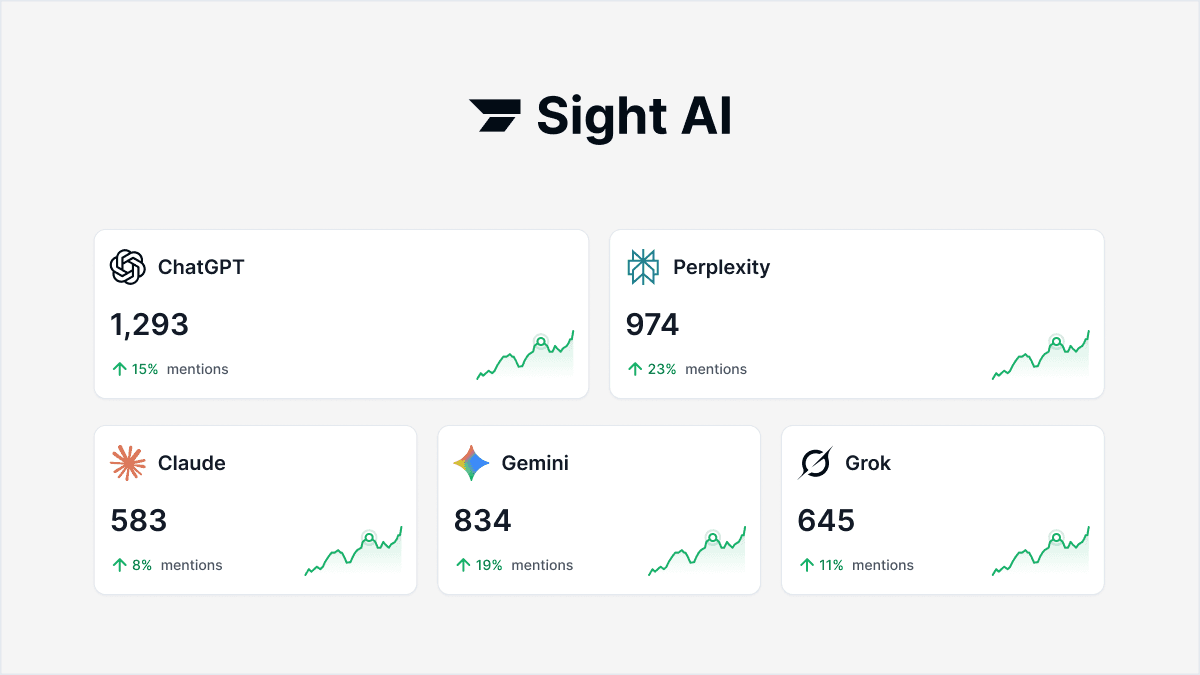
Tracking AI visibility requires monitoring across multiple platforms: ChatGPT, Claude, Perplexity, and others, because each platform has different training data, different retrieval mechanisms, and different response patterns. A brand that appears prominently on one platform may be virtually absent on another. Understanding this distribution is essential for prioritizing where to focus optimization efforts.
A practical AI visibility strategy combines three workstreams running in parallel. First, content creation targeting specific AI-relevant prompts: publishing in-depth, well-structured content that addresses the exact questions and use cases your audience is asking AI about. Second, off-site authority building: earning mentions in category-relevant publications, review platforms, and community discussions that build the third-party validation layer AI models weight heavily. Third, technical indexing hygiene: ensuring your content is crawlable, structured, and indexed quickly so it reaches AI systems without unnecessary delay.
Measurement closes the loop. By running prompt tracking on a regular cadence, brands can identify which queries they're winning, which they're losing, and how sentiment around their mentions is trending. This intelligence feeds back into content strategy, highlighting gaps to address and opportunities to pursue. It also enables competitive benchmarking: understanding not just your own AI visibility but how it compares to the brands competing for the same recommendations.
Sentiment analysis adds another dimension. It's not enough to appear in AI responses. How you appear matters. A brand that's mentioned with caveats or negative associations is being hurt by its AI visibility, not helped. Monitoring sentiment alongside mention frequency gives you the full picture of how AI platforms are representing your brand to potential customers.
Putting It All Together
AI platforms choose brands through a combination of signals that are, taken together, entirely learnable and optimizable. Content authority built through depth and consistency. Third-party validation earned through editorial mentions, community discussion, and analyst coverage. Technical discoverability ensured through indexing hygiene and structured data. Prompt-context relevance developed by understanding how your audience frames their queries and building content that addresses those specific intents.
None of these are black-box mysteries. They're extensions of disciplines that technically literate marketers already understand, applied to a new and rapidly growing channel. The brands that recognize this now and start building systematic AI visibility strategies are accumulating a compounding advantage. Every piece of authoritative content published, every third-party mention earned, and every technical gap closed increases the probability of appearing in AI-generated recommendations, and that probability compounds over time as the signals reinforce each other.
The window for early-mover advantage in AI visibility is open right now. Most of your competitors are not yet measuring this, which means the gap you close today is one they'll have to work harder to catch up to later.
Stop guessing how AI models like ChatGPT and Claude talk about your brand. Get visibility into every mention, track content opportunities, and automate your path to organic traffic growth. Start tracking your AI visibility today and see exactly where your brand appears across top AI platforms.